

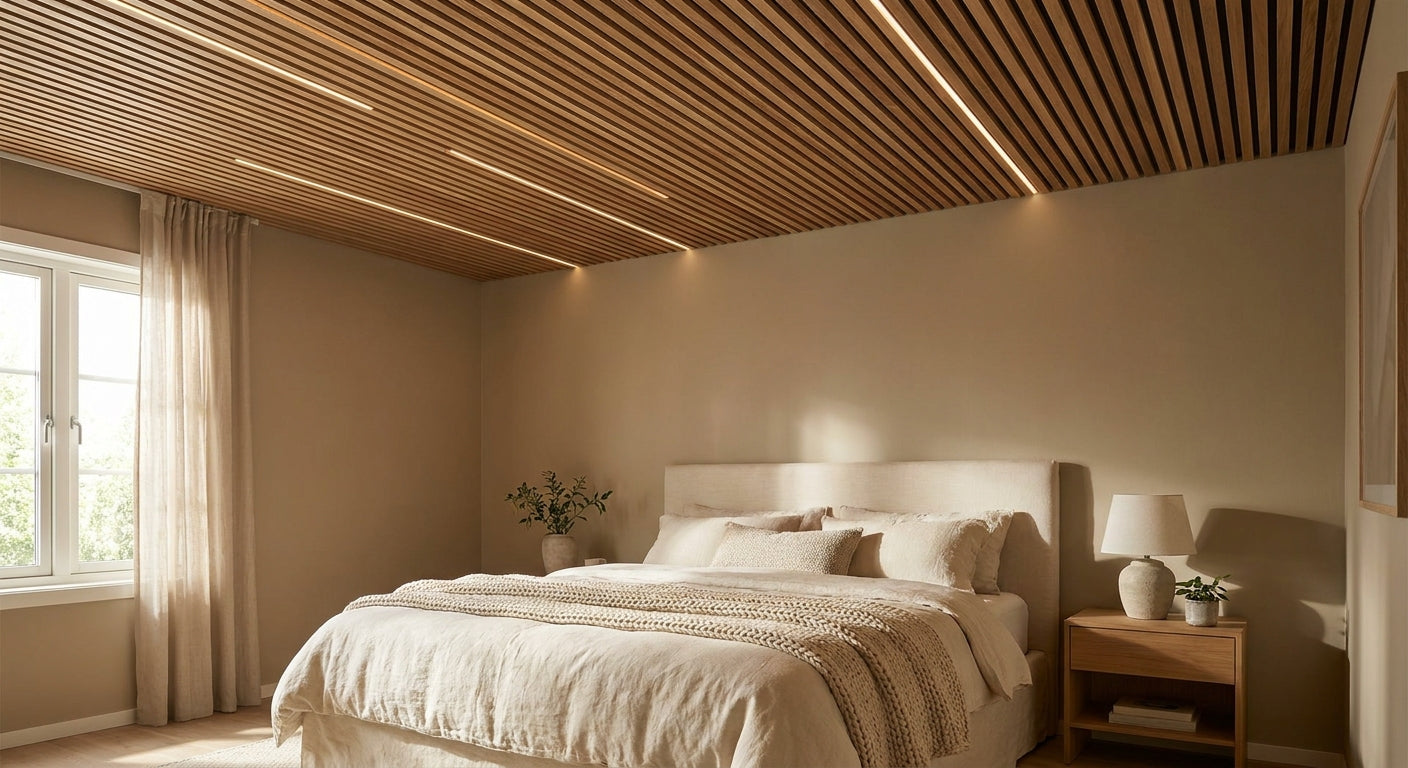
Wooden slat panels for bedroom ceilings transform a flat, overlooked surface into an architectural feature — and in 2026, they are one of the fastest-growing ceiling treatments in UK residential interiors.
TL;DR: Wooden slat panels for bedroom ceilings work best when weight, finish, acoustic performance, and fixing method are matched to the room. Natural oak and smoked oak are the strongest choices for most bedrooms in 2026. Panels with an integrated felt backing absorb sound as well as looking good. Order a sample before committing to a full ceiling — colour reads very differently overhead than on a vertical wall.
Why ceiling panels deserve more attention than you're giving them
Most people spend their panel budget on a single feature wall, then wonder why the room still feels flat. The ceiling is the largest uninterrupted plane in a bedroom. Covering it with horizontal slats adds depth, draws the eye upward, and — when the panels carry a felt backing — measurably reduces echo from hard floors and glass. In 2026, acoustic performance and aesthetics are no longer a trade-off: the same panel does both.
Who this is for
This guide is for homeowners and interior designers fitting wooden slat panels to a bedroom ceiling — not a wall. The ceiling application changes every decision: weight matters more, adhesive must be rated for overhead use, finish needs to read well under artificial lighting pointing upward, and acoustic absorption becomes a genuine bonus rather than a secondary concern. If you are fitting panels to a bedroom wall instead, the criteria differ enough to warrant a separate read.
What to look for in wooden slat panels for a bedroom ceiling
Panel weight and substrate
A standard acoustic slat panel runs roughly 6–9 kg per square metre. That sounds modest until you factor in adhesive cure time and the risk of panels sagging before the bond sets. Look for panels built on an MDF or HDF substrate rather than particleboard — the denser core holds screws and glue anchors far more reliably overhead. Akuwoodpanel.uk panels use an HDF backing, which keeps the weight predictable and the bond secure.
Finish and light behaviour
Natural oak reads warm and pale under downlighters; smoked oak reads as a deep charcoal that contracts the ceiling visually — useful in a room with high ceilings but stark in a low room. Black oak takes this further and is best reserved for ceilings above 2.5 m. Grey oak splits the difference: cool-toned, contemporary, and forgiving under most colour temperatures. In 2026, the most popular bedroom ceiling finish in UK projects is natural oak, followed closely by smoked oak for rooms going for a darker, boutique-hotel feel.
Acoustic backing
Slat panels without felt backing are purely decorative — the gaps between slats do not absorb meaningful sound. Panels with a grey felt backing trap mid-frequency sound in the air cavity behind the felt, reducing reverberation time in a typically furnished bedroom by a measurable margin. For a bedroom, this matters: hard ceilings reflect morning alarm sounds and TV audio directly back at the occupant. Choose felt-backed panels if noise or echo is any part of the brief.
Fixing method compatibility
Bedroom ceilings in UK homes are almost always plasterboard on timber joists. You have two fixing routes: panel adhesive plus temporary mechanical support while the glue cures, or screw-through-panel into joists. Adhesive-only is cleaner but demands a high-tack formulation rated for overhead applications — standard grab adhesive is not sufficient. If you are using screws, the screw head should countersink into the slat, not sit proud, or the line of slats will show fixings. End pieces cover the cut edges at the perimeter; without them, a bedroom ceiling installation looks unfinished at the cornice line.
Panel dimensions and room proportion
Standard acoustic slat panels are typically 240 cm × 60 cm. A 3 m × 4 m bedroom ceiling takes approximately 8–10 panels depending on layout and waste. Running the slats along the longer dimension of the room makes the space read as wider; running them along the shorter dimension makes it read as longer. Decide this before ordering — it changes how many end-piece trim pieces you need and which direction you start the first row.
Colour sample before full order
This cannot be overstated. Colours that look warm on a vertical wall look cooler overhead because the light source (usually a pendant or downlighter) is now below the surface. Every major finish looks slightly different on a ceiling. Akuwoodpanel.uk offers physical samples for every finish — natural oak sample, smoked oak sample, and others — for exactly this reason. Hold the sample against the ceiling under your actual room lighting before placing a full order.
Top picks for bedroom ceilings in 2026
The safe pick — Natural Oak with Grey Felt
Hook: Works in virtually every bedroom, from Scandi-minimalist to warm-contemporary.
The natural oak veneer is pale, grain-varied, and neutral enough not to date. The grey felt backing adds acoustic absorption without adding visible bulk. This is the panel that interior designers specify most often for bedroom ceilings in 2026 because it does not require a committed design direction to look right.
Verdict: Buy. The wooden wall panel natural oak grey felt is the lowest-risk choice for a bedroom ceiling installation.
The moodier option — Smoked Oak
Hook: Adds weight and atmosphere; best for bedrooms designed around a dark palette.
Smoked oak reads as a deep warm charcoal — not black, but distinctly dark. On a ceiling, it creates an enveloping effect that pairs well with linen bedding, matte walls, and warm filament lighting. It demands enough ceiling height (2.4 m minimum is the practical floor; 2.6 m+ is comfortable). Below that, it compresses the room noticeably.
Verdict: Buy if the room has ceiling height and a committed dark interior scheme. Consider the smoked oak panel as a ceiling-height test first.
The contemporary neutral — Grey Oak
Hook: Cool-toned and contemporary without going full-dark.
Grey oak sits between natural oak and smoked oak on the tone scale. It reads as a cool mid-grey with visible grain, which suits rooms with grey, white, or blue-toned walls. It performs better than smoked oak in lower-ceilinged rooms because the cooler tone does not absorb as much perceived light.
Verdict: Consider. Strong choice for new-build bedrooms or rooms with cooler north-facing light.
The bold statement — Black Oak
Hook: High-drama; only correct in the right context.
Black oak on a ceiling is a genuine design commitment. It works in rooms above 2.5 m with strong artificial lighting and a deliberately dark or monochromatic palette. In a standard UK bedroom at 2.4 m, it makes the room feel smaller and darker than most occupants find comfortable. Not wrong — just precise in its application.
Verdict: Skip unless the room brief explicitly calls for a dark cocoon effect and the ceiling height supports it.
What to avoid
- Standard grab adhesive for overhead fixing. Most grab adhesives sold in DIY sheds are tested for vertical application. Overhead, the panel weight during cure time can cause slippage or partial bond failure. Use an adhesive rated for ceiling use, or supplement with temporary batten support.
- Skipping end pieces on the perimeter. Cut MDF edges are visible and absorb moisture differently to the face veneer. Without end-piece trim, the edge of every panel row looks raw. End pieces are available in every finish and are not optional on a ceiling installation.
- Installing panels in a room with unresolved moisture. Bedrooms with condensation problems — single glazing, poor ventilation, or en-suite steam — will cause the veneer to lift at the edges over time. Fix the moisture source before panelling overhead. On a ceiling, a lifting veneer edge is far harder to press back and reglue than on a wall.
Verdict comparison table
| Finish | Acoustic backing option | Best ceiling height | Room palette | 2026 verdict |
|---|---|---|---|---|
| Natural Oak (Grey Felt) | Yes | Any | Warm, neutral, Scandi | Buy |
| Smoked Oak | Optional | 2.4 m+ | Dark, boutique, moody | Buy (with height) |
| Grey Oak | Optional | Any | Cool, contemporary | Consider |
| Black Oak | Optional | 2.5 m+ | Monochromatic, bold | Skip unless committed |
| Walnut | Optional | 2.4 m+ | Warm, classic | Consider |
FAQ
What are the best wooden slat panels for a bedroom ceiling? Natural oak with grey felt backing is the strongest all-round choice for bedroom ceilings in 2026. It suits most ceiling heights, adds acoustic absorption, and does not commit the room to a specific colour palette.
Do wooden slat panels work on a bedroom ceiling without screws? Yes, but only with a high-tack adhesive rated for overhead use. Standard grab adhesive is not sufficient — the panel weight during cure time will cause slippage. For a cleaner finish, combine adhesive with temporary batten support until the bond fully cures (typically 24 hours).
How many panels do I need for a bedroom ceiling? A standard 3 m × 4 m bedroom ceiling needs approximately 8–10 panels, accounting for trimming waste. Use the longest wall dimension to orient the slats, then calculate rows. Always add one extra panel for cuts.
Is black oak too dark for a bedroom ceiling? In most UK bedrooms at 2.4 m ceiling height, yes. Black oak absorbs light overhead and can make the room feel oppressive. At 2.5 m or above, with adequate artificial lighting, it works as a dramatic design statement. At standard height, grey oak or smoked oak achieves a similar effect without the compression.
Do acoustic slat panels actually reduce noise in a bedroom? Yes, when they include a felt backing. The felt layer traps mid-frequency sound in the air gap behind it, reducing reverberation. In a bedroom with hard flooring and minimal soft furnishings, a felt-backed ceiling panel makes a measurable difference to echo and morning sound reflection.
Can wooden slat panels go on a bedroom ceiling in a rented property? Only if the landlord permits structural fixings. Adhesive-only installation is reversible on walls but leaves adhesive residue on a ceiling that is harder to remediate. Check the tenancy agreement before proceeding, and consider whether the deposit risk outweighs the aesthetic gain.
What finish looks best on a bedroom ceiling under warm lighting? Natural oak and walnut both read warm under 2700K–3000K downlighters — the most common colour temperature in UK bedroom lighting. Smoked oak reads slightly warmer overhead than on a wall under warm light. Grey oak and black oak retain their cool/neutral read regardless of light colour temperature.
How do I finish the edges of slat panels on a ceiling? Use matching end pieces in the same finish as the main panels. These cover the cut MDF edges at the perimeter and along any junction where panels meet a wall or coving. Without them, the raw edge is visible and will absorb moisture differently to the face veneer.
One last thing
The single most common mistake on a bedroom ceiling installation in 2026 is starting the first row at the wall and working across — then discovering the final row needs a 3 cm sliver of panel. Measure the ceiling width, divide by panel width, and work out whether to centre the layout or offset it. A centred layout means symmetrical part-panels on both sides; an offset layout hides the awkward cut behind a wardrobe or in a corner. Plan this on paper before the first panel goes up. It costs nothing and saves a wasted panel.
For a step-by-step walkthrough of the ceiling installation process, see the guide on how to panel a ceiling with wooden slat panels.
Share:
Exterior Cladding for Porch Walls: Top Picks 2026
Decorative Wall Panels for Alcoves: 2026 Buyer's Guide