

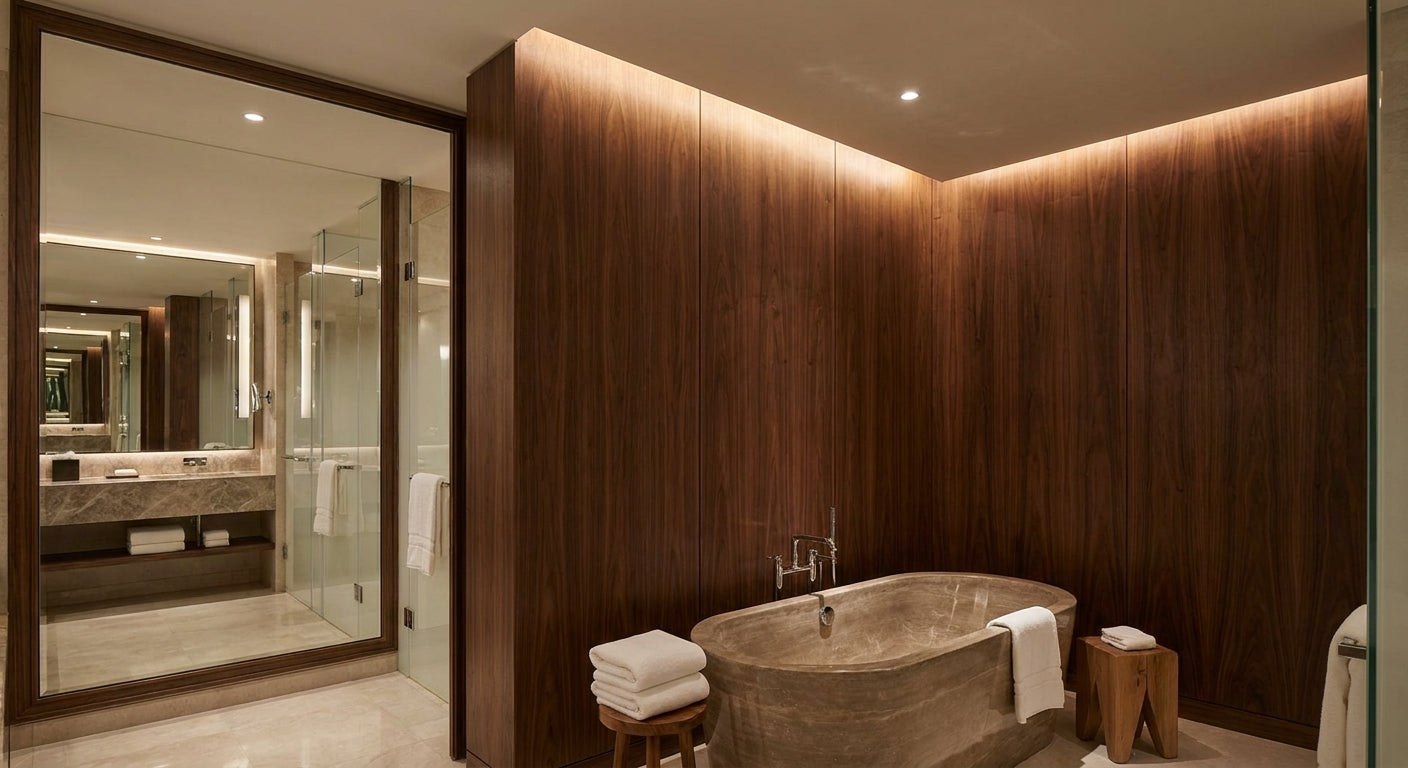
Walnut wall panels turn a flat hotel bathroom wall into the one thing guests photograph and post — without the rot risk everyone assumes comes with real wood near water.
TL;DR
Walnut wall panels for hotel bathroom feature walls work best on a dry accent wall — the vanity run, the wall behind the mirror, the entry reveal — never inside the shower spray zone. The Wooden Wall Panel Walnut is the safe pick for most 2026 refurbishments: a 3-sided real wood veneer finish over an acoustic felt backing that also kills the echo tiled bathrooms are famous for. Order the sample panel first if you're speccing more than a handful of rooms — walnut reads differently under bathroom lighting than it does on a showroom wall. Verdict: Buy for the feature wall, Skip for anywhere water lands directly.
Why this matters
Hard tile, a mirror, and a hard floor make hotel bathrooms some of the most acoustically brutal rooms in a building — every tap drip and hairdryer echoes. Interior teams have been solving that with wood accent walls for years, but the material choice matters more in a bathroom than a bedroom: the wrong veneer swells, the wrong fixing fails in humidity, and the wrong batch looks inconsistent across 40 identical rooms. Walnut specifically gets picked over oak finishes in luxury bathroom briefs because it reads darker and more expensive under the warm, low lighting most boutique hotels use in 2026 bathroom design.
Who this is for
This guide is for the person actually speccing the bathroom package — a hotel refurbishment project manager, an interior designer working a boutique or four-star brief, or a developer rolling out the same bathroom finish across 20 to 80 rooms. You need a finish that photographs well, survives housekeeping's cleaning products, and doesn't require re-speccing room by room. If you're doing a single ensuite in a private home, most of this still applies, but the batch-consistency problem below matters far less to you.
Start with the walnut wall panel as your baseline spec — everything else in this guide compares against it.
What to look for in walnut wall panels for a hotel bathroom
Where the panel is actually allowed to go
Real wood veneer panels are not shower cladding. Every credible spec for walnut wall panels for hotel bathroom feature walls puts the panel on a dry wall — the vanity backdrop, the entry wall, the wall opposite the shower — and leaves the wet zone to tile, stone, or waterproof cladding. Get this wrong once in a 60-room refit and you're re-speccing the whole floor.
Acoustic backing, not just a nice finish
A tiled bathroom with a hard floor and a mirror bounces sound worse than almost any other room in the building. Panels with acoustic felt backing absorb some of that instead of adding another hard reflective surface, which is the actual functional reason wood panelling gets specced in bathrooms at all, not just the look.
Veneer consistency across room blocks
One room looking slightly different from the next is the fastest way a hotel bathroom refit looks cheap instead of premium. Real wood veneer has natural grain variation, so batch consistency across a multi-room order matters more here than in a single residential project.
Panel size against your ceiling height
Walnut wall panels come in two length formats — 240 cm and 300 cm. A standard hotel bathroom ceiling usually sits under 240 cm, so that format avoids on-site cutting; a floor-to-ceiling feature wall in a taller suite bathroom is where the 300 cm format earns its keep.
Fixing method that survives humidity swings
Bathrooms swing between dry and steamy several times a day. A fixing approach that relies purely on nails or screws can work loose faster than one that pairs mechanical fixing with a flexible adhesive built for interior panel work.
Finishing detail at the panel edge
Where a walnut panel meets tile, a plain cut edge looks unfinished under hotel-grade scrutiny. A matched end piece gives a clean termination line instead of an exposed panel edge.
Top picks for walnut wall panels in a hotel bathroom
The safe pick — Wooden Wall Panel Walnut. Three-sided real wood veneer over acoustic felt backing, available in the 240 cm and 300 cm formats that cover almost any hotel bathroom ceiling height. This is the panel most 2026 boutique hotel bathroom briefs default to because it does the two jobs a bathroom feature wall actually needs — looks expensive, kills some echo — without asking the designer to gamble on a niche finish. Verdict: Buy.
The wildcard — Hexagon Acoustic Panel Walnut with Grey Felt. Same walnut veneer, geometric hexagon layout instead of the straight slat run. Use it behind the vanity mirror in a signature suite bathroom where you want one room in the block to read differently from the standard floor plan. It costs more attention to install correctly than the standard slat panel, so reserve it for feature suites rather than a full 80-room roll-out. Verdict: Consider for signature rooms only.
The finishing detail — End Piece Wooden Wall Panel Walnut. This is the accessory that stops the panel edge looking cut-off where it meets the tiled wet zone. Skip it and even a well-specced walnut wall looks unfinished in photos. Small line item, outsized effect on how premium the room reads. Verdict: Buy alongside any walnut panel order for a bathroom.
Test before you commit — Sample Wooden Wall Panel Walnut. Bathroom lighting — usually warmer, dimmer, more mirror-bounced than a bedroom — changes how walnut reads compared with a showroom sample under daylight. Order the sample against your actual bathroom lighting scheme before locking a multi-room order in 2026; it's the cheapest insurance against a re-order across 40 rooms. Verdict: Buy as your first step, not an optional extra.
What to avoid
- Real wood veneer inside the shower enclosure. It looks right in a rendering and fails in six months of daily steam exposure — that wall needs tile or a waterproof cladding board, not walnut veneer.
- Mixing unmatched batches across a room block. Ordering walnut panels in separate small batches for a 30-room refit risks visible grain and tone shifts room to room, which reads as a budget finish, not a premium one.
- Skipping the acoustic backing on a shared-wall bathroom. If the bathroom backs onto a corridor or an adjoining room, a panel without acoustic felt backing solves the look problem and does nothing for the noise complaint.
Verdict comparison
| Pick | Best for | Key spec | Verdict |
|---|---|---|---|
| Wooden Wall Panel Walnut | Standard bathroom feature wall, any room count | 240 cm / 300 cm, 3-sided veneer, acoustic felt backing | Buy |
| Hexagon Acoustic Panel Walnut with Grey Felt | Signature suite accent wall | Hexagon layout, walnut veneer | Consider |
| End Piece Wooden Wall Panel Walnut | Clean edge at tile junction | Matched trim finish | Buy |
| Sample Wooden Wall Panel Walnut | Pre-order lighting check | Small-format swatch | Buy first |
FAQ
Is walnut a good choice for a hotel bathroom feature wall? Yes, on a dry accent wall away from direct water spray — walnut veneer panels with acoustic felt backing are a standard 2026 spec for boutique hotel bathrooms because they add warmth against cold tile and cut some echo.
Can you put real wood panels in a shower area? No. Walnut wall panels belong on the vanity wall, entry wall, or feature wall opposite the shower, not inside the wet zone itself — that area needs tile, stone, or waterproof cladding.
What size walnut panel fits a standard hotel bathroom? Most standard hotel bathroom ceilings sit under 240 cm, so the 240 cm panel format avoids on-site cutting; taller suite bathrooms with floor-to-ceiling feature walls suit the 300 cm format better.
Do walnut wall panels help with bathroom acoustics? Yes — the acoustic felt backing behind the veneer absorbs sound that would otherwise bounce off tile, mirror, and hard flooring, which is the functional reason wood panelling shows up in bathroom specs at all.
How do you keep walnut panels consistent across a multi-room hotel refit? Order from the same production batch where possible and confirm veneer grain consistency before a full room-block order — natural wood variation is normal, but visible mismatch between rooms reads as a cheap finish.
Should you order a sample before speccing a full hotel bathroom refit? Yes. Bathroom lighting is usually warmer and dimmer than a showroom, and walnut can read differently under it — a sample panel checked against your actual lighting avoids a costly re-order across dozens of rooms.
What finishes goes at the edge where a walnut panel meets tile? A matched end piece gives a clean termination line instead of an exposed panel edge, which matters more in a hotel bathroom under close guest scrutiny than in a residential one.
Is walnut more expensive to spec than oak for a hotel bathroom? Pricing varies by supplier and order volume — check current panel pricing directly, but designers generally choose walnut over lighter oak finishes for bathrooms specifically because it reads darker and more premium under low, warm hotel lighting.
One last thing
The detail most fit-out teams miss in 2026 isn't the veneer choice, it's the acoustics: a tiled bathroom with a mirror and hard floor is one of the most reflective rooms in any hotel, and a plain painted wall does nothing to fix that. The felt backing behind a walnut panel is doing real acoustic work, not just covering a wall — which is exactly why it belongs on the feature wall and nowhere near the shower spray.
Share:
Acoustic Panels for Sports Hall Walls: 2026 Verdict
Best Exterior Cladding for Flat Roof Garden Room 2026