

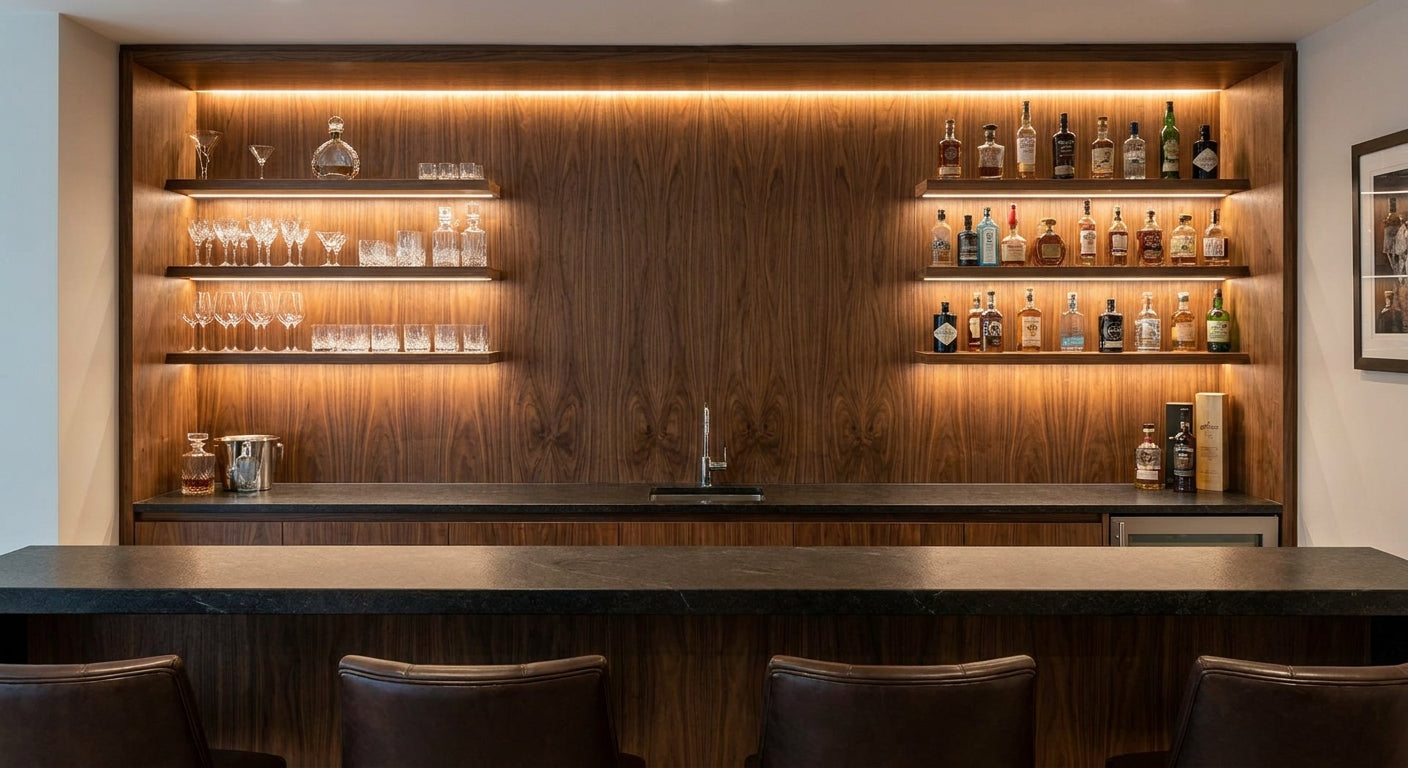
A home bar feature wall needs wood that reads as premium under low light, survives splashes near the optics, and quietens the clink-and-chatter bounce off tile and glass. Walnut wall panels for home bar walls solve all three at once when you pick the right finish, size and trim.
TL;DR
Akustiq UK's walnut wood wall panel is the strongest pick for a home bar feature wall in 2026: a 3-sided real wood veneer over acoustic felt backing that darkens the room without going flat black, available in 240cm and 300cm lengths. Buy the full panel for the main run, Buy an end piece for clean sight lines around optics and shelving, and order a sample first if you're unsure how the grain reads under your bar lighting. Skip painted MDF slat imitations near sinks and ice wells — they peel.
Why this matters
Bar rooms are acoustically brutal: hard flooring, glass shelving, a fridge compressor, and a group of people talking over music. Bare plaster or painted drywall bounces every one of those sounds straight back at your guests. A walnut wood wall panel with felt backing absorbs mid and high frequencies instead of reflecting them, which is why acoustic panelling behind a bar counter does double duty — it looks finished and it stops the room sounding like a squash court.
Walnut specifically earns its place in bar design because it reads dark and warm under pendant lighting and LED strip without looking like a cave. Pale oak finishes wash out under warm bulbs; black oak can look flat and cold against brass fixtures. Walnut sits in between, which is why it shows up repeatedly in restaurant and bar fit-outs — the same logic covered in smoked oak acoustic panels for bars and restaurants applies here, just one shade lighter.
Who this is for
This guide is for anyone panelling a home bar, snug bar, or basement bar feature wall in 2026 — whether that's a single accent wall behind the bottle shelf or a full wrap around a peninsula bar. It assumes you want a finish that photographs well, survives the odd splash, and doesn't need repainting every couple of years.
What to look for in walnut wall panels for a home bar
Real wood veneer coverage
A panel with veneer on three sides (front and both edges) hides the raw MDF core completely, even where panels butt together at an angle or meet a corner. That matters more in a bar than a living room because guests stand close, lean on the wall, and look at it from odd angles while waiting for a drink.
Acoustic felt backing
Felt backing is what turns decorative panelling into a functional fix for echo. In a bar with a tiled splashback, glass shelving, and a hard floor, you need every soft surface you can get without hanging fabric everywhere.
Panel size fit for your wall
Akustiq UK's walnut panels come in 240cm and 300cm formats. Measure your feature wall height and width before ordering — a 300cm run behind a standard 2.4m ceiling wastes offcuts, while a wall taller than 240cm needs the longer format to avoid a visible horizontal seam right at eye level.
Grain tone under bar lighting
Walnut's grain runs warmer and more varied than black oak, which matters under dimmed pendant lights where flat, uniform finishes can look cheap. Check a sample against your actual bulb colour temperature before committing to a full wall.
Trim and end pieces
Bar walls usually have interruptions — optics brackets, a shelf bracket, a socket for the fridge. An end piece in matching walnut gives you a clean finished edge at these cut points instead of exposed board.
Installation suited to a wet zone
Bar walls sit near ice buckets, condensation, and the odd spilled drink. Panel glue rated for interior use holds slats without visible fixings, which keeps moisture out of screw holes that mechanical fixing would otherwise leave.
Top picks for a walnut home bar feature wall
1. Walnut wood wall panel — the anchor pick. This is the main event: 3-sided real wood veneer over acoustic felt, in 240cm and 300cm lengths. One spec that matters here is the felt backing thickness relative to standard MDF slat cladding — it's what gives you sound absorption on top of looks. Buy it for the primary run of your feature wall.
2. Walnut sample panel — the low-risk test. Before committing to a full wall's worth of panels, a physical sample lets you check the grain and tone against your actual bar lighting rather than a screen. It costs far less than a returned order. Buy one if you haven't seen walnut in person under your own bulbs.
3. Walnut end piece — the finish that stops it looking half-built. End pieces cap exposed edges where the panel run meets a corner, a doorway, or a shelf bracket. Skipping this is the single most common reason a panelled bar wall looks unfinished in photos. Buy it alongside your main panel order, not as an afterthought.
4. High-tack panel glue, 290ml — the adhesive that holds it invisibly. For a bar wall you don't want visible screws catching light or corroding near condensation. A tube of panel glue rated for interior wood panel fixing keeps the surface clean. Buy it as a non-negotiable line item, not an optional extra — it is the fixing method, not a backup.
What to avoid
- Painted MDF slat imitations. They look similar to real wood veneer in photos but chip and swell near sinks, ice wells, and condensation — a bar's exact conditions.
- Panels with no felt backing in a hard-floored bar room. Decorative slats alone do nothing for the echo problem that a bar with tile, glass, and no soft furnishings will always have.
- A finish that fights your bar's existing tones. Very pale oak against a dark leather bar front or brass taps can look mismatched; walnut's mid-dark warmth is the safer bridge between light and black finishes.
Verdict comparison
| Product | Veneer sides | Size options | Felt backing | Best for | Verdict |
|---|---|---|---|---|---|
| Walnut wood wall panel | 3-sided | 240cm / 300cm | Yes | Main feature wall run | Buy |
| Walnut end piece | 3-sided match | Cut to fit | Yes | Corners, doorways, brackets | Buy |
| Walnut sample | 3-sided | Swatch size | Yes | Testing tone under bar lighting | Buy |
| High-tack panel glue (290ml) | n/a | 290ml tube | n/a | Fixing without visible screws | Buy |
| Painted MDF slat panel | None | Varies | Rarely | Budget accent only, not wet zones | Skip |
FAQ
What's the best wood finish for a home bar feature wall? Walnut is the strongest all-rounder for 2026 home bar builds because it reads warm and dark under pendant lighting without going as flat as black oak. Smoked oak and black oak both work if you want a moodier, more monochrome bar look instead.
Is walnut better than black oak for a bar wall? Walnut suits bars with brass fixtures, warm bulbs, or leather furniture, while black oak suits a more minimalist, monochrome bar setup. Neither is objectively better — it depends on the rest of your bar's material palette.
How much wall panel do I need for a home bar? Measure your feature wall's height and width first, then choose 240cm or 300cm panel lengths based on which produces fewer offcuts and avoids a horizontal seam at eye level. Order a sample before calculating full quantities so the finish is confirmed.
Do acoustic wall panels actually reduce noise in a bar room? Yes — the felt backing behind the wood veneer absorbs mid and high frequency sound that hard floors, tile, and glass shelving would otherwise bounce back into the room. This matters more in bar rooms than most spaces because they combine all three hard surfaces at once.
Can I fit walnut wall panels without screws? High-tack panel glue holds wood wall panels to a wall without visible fixings, which keeps the surface clean for a bar setting where screw heads would catch light or corrode near condensation.
What should I avoid when panelling a bar wall? Avoid painted MDF slat imitations near sinks or ice wells since they peel with moisture, and avoid skipping end pieces, which is the most common reason a panelled wall looks unfinished.
How do end pieces improve a walnut panel installation? End pieces cap exposed panel edges at corners, doorways, and shelf brackets, giving a bar wall a finished factory-edge look instead of visible raw board at every cut point.
Should I order a sample before buying full walnut panels? Yes — a sample lets you check walnut's grain and tone against your bar's actual lighting before committing to a full wall's worth of panelling, which is far cheaper than reordering after installation.
One last thing
The detail most home bar builds miss isn't the panel choice — it's lighting temperature. Walnut looks noticeably different under a 2700K warm bulb than under a cooler 4000K strip light, so test your sample under the exact bulb you'll run behind the bar, not daylight from a window, before ordering the full run.
Share:
Best Walnut Wall Panels for Luxury Interiors (2026)
How to Cover an Ugly Interior Wall with Wood Panels (2026)