

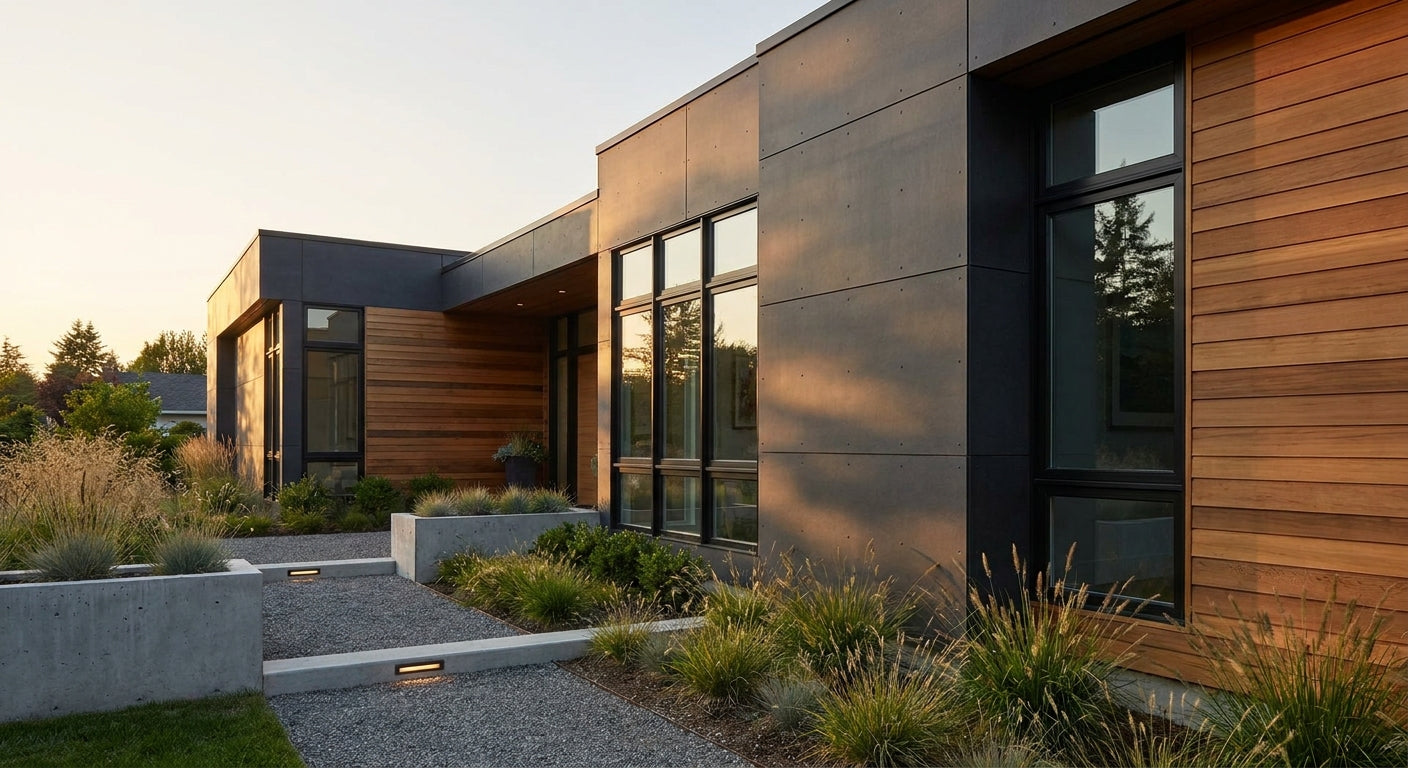
Choosing the right outdoor wall panels for a house exterior comes down to three things: material durability, weather resistance for the UK climate, and how the finish reads from the street. This guide covers every key decision, names specific finishes from Akustiq UK, and gives you a clear verdict on each.
TL;DR: The best outdoor wall panels for house exterior use in the UK in 2026 are composite cladding panels — they handle rain, frost, and UV without warping or rotting. Akustiq UK offers exterior cladding in four finishes (Birch, Oak, Black, Stone Grey), available in full panels and matching trims. Black is the strongest choice for modern homes; Stone Grey suits rendered facades. Order a sample before committing to a full wall.
Why this matters
UK homes lose heat through poorly sealed facades and gain damp through cladding that wasn't built for outdoor use. Beyond the thermal argument, the exterior is the first thing a viewer, buyer, or neighbour sees. In 2026, modern house design increasingly uses contrast cladding — a dark panel against white render, or a natural wood-grain finish on a single-storey extension — to give new builds and renovations a distinctive look without a full architectural overhaul. The right panel does both jobs: it protects the wall and defines the aesthetic.
Who this is for
This guide is for homeowners renovating an existing house exterior, self-builders specifying cladding for a new build, and contractors fitting out garden studios, flat-roof extensions, garages, or porches. If you want a panel that installs with screws onto a timber frame or directly over existing render, and you need it to survive a British winter without annual maintenance, you are in the right place. Interior acoustic panels are a different product — this guide covers exterior-rated cladding only.
What to look for in outdoor wall panels for house exteriors
Weather and moisture resistance
The UK averages over 1,100 mm of rainfall per year in wetter regions. Any panel used on a house exterior must be rated for sustained moisture exposure. Composite panels outperform untreated timber here — they do not absorb water, so they will not split, swell, or grow mould over a standard 10–15 year lifecycle. Check that the product explicitly states outdoor or exterior use; indoor panels with a wood veneer finish are not suitable substitutes.
UV stability
Dark finishes — particularly black and smoked tones — are vulnerable to UV bleaching if the surface coating is not UV-stabilised. A panel that looks sharp in year one but fades to a patchy grey by year three is a poor investment. Akustiq UK's exterior wall cladding panel in Black uses a UV-resistant finish, which is why it holds its colour on south-facing elevations where sun exposure is highest.
Finish and colour match to your elevation
The panel colour needs to work with your existing render, brickwork, or window frames — not just look good in isolation. Stone Grey reads as neutral and pairs with light render or off-white frames. Oak adds warmth and suits timber-frame buildings or extensions with natural material palettes. Black makes the strongest architectural statement and is the dominant choice for flat-roof extensions and garage conversions in 2026.
Panel size and coverage per board
Larger panels mean fewer joins, which means a cleaner finish and fewer potential water ingress points. Measure your wall area carefully before ordering and account for window and door cut-outs. Akustiq UK supplies cladding boards alongside full panels, so you can fill awkward widths without cutting a full-size panel down to a sliver.
Fixing system and edge finishing
A panel that arrives without a matched fixing kit or trim creates problems at corners and perimeter edges. Exposed cut edges on composite panels can delaminate if not finished correctly. Akustiq UK supplies colour-matched screws, finishing trims, and corner trims for each finish — Birch, Oak, Black, and Stone Grey — so you do not have to source hardware separately and risk a colour mismatch at the edges.
Sample availability
Colour calibration on a screen is unreliable. A finish that looks warm oak on a monitor can read as yellow-orange against your brickwork in direct sunlight. Always order a physical sample before buying full panels. Akustiq UK offers outdoor panel samples for all four exterior finishes, which is the single most useful step you can take before committing to a wall.
Top picks for modern house exteriors
Black — the statement finish
The architectural pick. Black composite cladding is the default choice for flat-roof extensions, garage conversions, and new-build accent walls in 2026. The contrast against white or light grey render is hard to beat, and the finish reads as intentional rather than accidental. Akustiq UK's exterior wall cladding panel in Black comes with matched black screws, corner trims, and finishing trims so the entire installation holds one colour.
- One spec that matters: UV-resistant surface coating — critical for south-facing walls
- Concrete number: Available in a sample format before full-panel purchase, so zero commitment to colour before you see it in situ
- Verdict: Buy — the strongest choice for modern house exteriors in 2026
Stone Grey — the neutral facade
The safe pick. Stone Grey works across the widest range of house types. It pairs with rendered walls, concrete, and aluminium window frames without competing for attention. It is the right call when the goal is a clean, contemporary look that adds visual weight to a plain elevation without making a loud statement. Matching trims and screws are available in Stone Grey.
- One spec that matters: Neutral tone sits between warm and cool, so it reads consistently in both overcast and direct light — important in the UK
- Verdict: Buy — reliable across most UK house types
Oak — the warm-toned option
The natural look. Oak-finish exterior cladding suits self-build homes, barn conversions, and any elevation that already carries timber or natural material elements. It adds warmth without looking like untreated wood, and it carries the UV-resistant coating that raw timber would need to be treated with annually. Order a sample outdoor wall panel in Oak to check the tone against your existing materials before ordering full boards.
- One spec that matters: Composite construction means no annual oiling or treating, unlike real timber cladding
- Verdict: Buy for timber-frame or barn conversion projects; Consider for brick elevations where the warm tone may clash
Birch — the light finish
The wildcard. Birch is the lightest exterior finish in the Akustiq UK range. It works well on garden studios and outbuildings where a clean, Scandinavian-influenced look is the goal, and it pairs with black window frames for high contrast without the full-wall drama of all-black cladding. Less common on main house elevations, but strong on single-storey additions.
- Verdict: Consider — strong for garden buildings and outbuildings, less certain as a primary house finish
What to avoid
- Using indoor acoustic panels on exterior walls. Indoor slat wall panels with wood veneer and acoustic felt backing are not weather-rated. Felt absorbs moisture; veneer exposed to rain will delaminate. The product categories are entirely separate — do not cross them.
- Skipping the trim kit. Composite panels cut at corners or perimeter edges expose the core material. Without a matched corner trim or finishing trim, water gets in at the edge and the aesthetic falls apart. Akustiq UK sells colour-matched trims for every exterior finish — use them.
- Ordering without a sample. Screen colours are not accurate for exterior finishes, especially on rendered walls where the background tone shifts the apparent colour of the panel. A sample costs a small amount and saves the cost of returning full panels that read wrong on the wall.
Comparison table
| Finish | Best for | UV stable | Trims available | Statement level |
|---|---|---|---|---|
| Black | Modern homes, flat-roof extensions, garages | Yes | Yes | High |
| Stone Grey | Rendered facades, neutral elevations | Yes | Yes | Medium |
| Oak | Timber-frame, barn conversions, self-builds | Yes | Yes | Medium |
| Birch | Garden studios, outbuildings, Scandinavian-style | Yes | Yes | Low–Medium |
Installation: what you need to know before you buy
All four Akustiq UK exterior cladding finishes install with screws onto a timber batten frame or directly onto a prepared substrate. The fixing system is straightforward, but the batten layout matters: vertical battens at 400 mm centres is the standard spacing for horizontal panel runs. If you are fitting onto an existing rendered wall, read the guidance on how to install outdoor cladding on a brick wall before you start — the substrate preparation step is where most DIY installations go wrong.
For porch and entrance wall applications where the cladding meets an internal space, detailing around the threshold is critical. Water management at the base of the panel — specifically a 15 mm minimum clearance above the finished floor or ground level — prevents capillary action drawing moisture up behind the panel.
If you are working on a project with a strong design direction — for example, pairing black exterior cladding with interior hardware in a complementary finish — it is worth thinking about the full material palette. For homes with a mid-century modern style approach to fittings and finishes, warm Oak or Birch cladding on the exterior can extend that material language from inside to out.
FAQ
What are the best outdoor wall panels for a house exterior in the UK? Composite cladding panels are the best outdoor wall panels for house exterior use in the UK in 2026. They resist moisture, UV, and frost without the maintenance burden of real timber. Akustiq UK offers four finishes — Black, Stone Grey, Oak, and Birch — with matched trims and fixings.
Are wood-effect cladding panels actually weatherproof? Yes, provided the panel is manufactured as an exterior product. Akustiq UK's exterior cladding panels are composite construction with a UV-resistant surface finish, not real wood veneer, so they do not absorb water or require annual treatment.
How much do exterior cladding panels cost? Price varies by finish and order volume. The most cost-effective approach is to calculate your wall area accurately, deduct window and door openings, and add 10% for cuts and waste. Akustiq UK sells individual panels, cladding boards for infill sections, and sample panels so you can check colour before purchasing at full scale.
Can I fit exterior wall panels myself? Yes. The fixing system uses screws through a batten frame — no specialist tools required. The most common DIY mistake is inadequate substrate preparation, particularly on rendered or brick walls. Use the correct batten spacing (400 mm centres for horizontal runs) and ensure the base detail keeps the panel clear of ground level.
Which exterior cladding colour is best for a modern house? Black is the dominant choice for modern house exteriors in 2026, particularly on flat-roof extensions, garage conversions, and new-build accent features. Stone Grey is the safer option if you want a contemporary look that works with a wider range of existing materials.
Do I need special fixings for exterior wall panels? Yes. Standard interior panel adhesive is not suitable for exterior use. Akustiq UK supplies colour-matched exterior screws for each finish. Using the correct fixings ensures the panel sits flush, holds over time, and does not leave rust streaks on the face of the cladding.
Can exterior cladding panels go over existing render? Yes, with the right preparation. The panels fix through battens to the wall behind — the battens are plugged and screwed into the render and masonry substrate. The render surface needs to be sound (no hollow sections or loose material) before battening out.
What is the difference between exterior cladding panels and interior acoustic panels? Exterior cladding panels are composite construction rated for outdoor exposure — no felt backing, no real wood veneer. Interior acoustic panels use a 3-sided real wood veneer with an acoustic felt backing designed to absorb sound. The two product types are not interchangeable. Using an indoor panel outside will cause it to fail within one to two winters.
One last thing
The detail that most buyers overlook is the corner trim. A flat wall run looks clean regardless of the panel finish. But an external corner — where two walls meet at 90 degrees — will show an ugly cut edge if you have not ordered the matching corner trim. Akustiq UK sells corner trims in all four exterior finishes. Order them at the same time as the panels, not as an afterthought when the installation is half done.
Share:
External Cladding for Semi-Detached Houses 2026
Best Exterior Cladding for New Build UK Estates 2026