

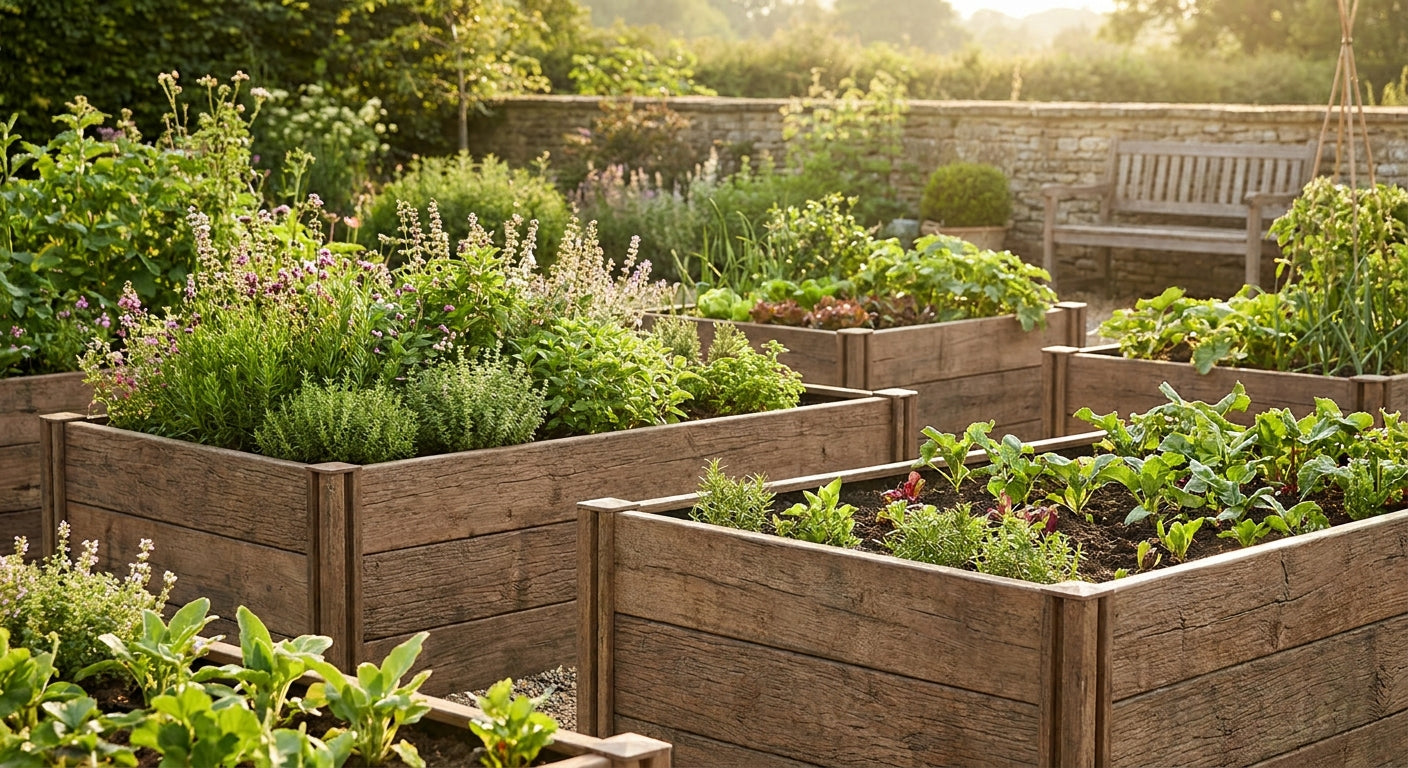
Raised bed surrounds need materials that can handle permanent soil contact, British rainfall, and years of freeze-thaw cycles — and still look good doing it. This guide covers which garden wall panels actually work for raised bed surrounds in 2026, what to look for before you buy, and where Akustiq UK's exterior cladding range fits into the picture.
TL;DR: The best garden wall panels for raised beds in 2026 are weather-rated composite or engineered-wood cladding panels. Akustiq UK's exterior wall cladding range — available in Birch, Oak, Black, and Stone Grey — is designed for outdoor use and holds up to moisture and UV exposure where standard interior timber panels fail. If you want a raised bed surround that looks architectural rather than utilitarian, these are the panels to spec. Indoor acoustic panels are not suitable for ground-level outdoor use.
Why this matters
Most raised bed guides point you toward sleeper timber, corrugated metal, or basic treated boards. But homeowners with a design-conscious garden — or those building raised beds as part of a wider landscaping scheme — are increasingly using wall cladding panels to match outbuilding or boundary wall finishes. Done right, cladded raised bed surrounds read as intentional garden architecture. Done wrong, they rot inside 18 months.
The stakes are specific: ground-level panels face moisture wicking up from soil, standing water after heavy rain, and direct contact with compost that stays damp for weeks at a time. A panel rated for exterior wall cladding handles this. A panel built for an indoor living room wall does not.
Who this is for
This guide is for homeowners, landscapers, and self-builders who are speccing raised bed surrounds as part of a broader garden design — not someone nailing together pallets for an allotment plot. You likely already have a garden studio, cladded fence panels, or exterior wall treatment in a specific finish, and you want the raised beds to match. You care about longevity as much as looks, and you want to understand exactly which panel type does the job before ordering.
What to look for in garden wall panels for raised beds
Weather and moisture resistance
This is the deciding criterion. Panels for raised bed surrounds live at ground level, in direct contact with damp soil on one face and exposed to rain, frost, and summer heat on the other. Look for panels explicitly rated for exterior use with a moisture-resistant substrate — not panels with a surface coating applied to an interior-grade core. Akustiq UK's exterior cladding panels use a composite construction designed for outdoor exposure, which is why they appear in garden building and outbuilding installs across the UK.
UV stability
In a UK garden, UV degradation is slower than in Mediterranean climates but still relevant over a 5–10 year lifespan. Panels that bleach, chalk, or peel within 3 years look worse than bare timber. Composite panels with a pigmented finish layer hold colour more consistently than panels relying on a surface stain alone.
Panel height and format
Raised beds typically sit between 30 cm and 90 cm tall. Standard exterior cladding boards are designed to run horizontally across a wall face, so you'll cut them to the bed height you need. Check the panel or board dimensions before ordering — Akustiq UK's cladding boards come in formats that allow clean horizontal runs with minimal waste at standard raised bed heights.
Soil-side protection
Even exterior-rated panels benefit from a liner on the soil-facing side. A heavy-duty polythene or root-barrier membrane between the compost and the panel face extends service life significantly. This does not replace the need for an exterior-rated panel — it supplements it.
Finish compatibility with your garden scheme
Raised beds read as furniture in the garden. If your outbuilding, fence capping, or pergola posts are in a specific finish — Black, Stone Grey, Oak — the raised bed cladding should match. Akustiq UK offers four exterior finishes: Birch, Oak, Black, and Stone Grey. All four are available as full panels and as sample panels, so you can check colour against existing surfaces before committing.
Fixing system
Cladding panels for raised beds are fixed to a timber or steel frame, not direct to soil. The fixing method matters: screw-fixed boards give you the ability to remove and replace individual lengths if one section is damaged, which you cannot do with adhesive-bonded systems. Akustiq UK supplies colour-matched screws for each exterior cladding finish, which keeps fixings invisible and prevents rust staining on the panel face.
Top picks for raised bed surrounds in 2026
The safe pick — Black exterior cladding
Black is the dominant finish in contemporary UK garden design in 2026. It reads cleanly against planting, doesn't show algae as visibly as pale finishes in the short term, and pairs with steel edging, black gravel, and dark timber decking. Akustiq UK's exterior wall cladding panel black is the finish most specified alongside garden studios and flat-roof extensions. One concrete number: the panel is designed for full exterior exposure, not just sheltered outdoor use — relevant for raised beds positioned in open garden areas.
Verdict: Buy if your garden scheme runs dark and you want the raised beds to read as part of a considered design.
The natural finish — Oak exterior cladding
Oak is the right call when the rest of the garden uses natural timber tones — cedar fencing, oak sleepers, or a timber-frame outbuilding. The Oak exterior cladding finish sits warmer than Birch and ages more gracefully than raw untreated timber would. Order a sample outdoor wall panel oak before committing if you're matching to an existing surface — monitor colours shift between screen and reality, especially under different light conditions.
Verdict: Buy for gardens with warm timber tones already present. Consider if you're starting from scratch and want to see it in context first.
The understated option — Stone Grey exterior cladding
Stone Grey works in gardens with render, concrete, or natural stone elements nearby. It's the neutral that doesn't fight for attention — useful if the planting is meant to be the focal point. Less common than Black but more distinctive than Birch for most UK gardens.
Verdict: Consider if your hard landscaping is already in grey tones. Skip if the garden is predominantly warm-toned.
The light finish — Birch exterior cladding
Birch is the palest of the four finishes. It works in Scandinavian-influenced gardens with white render and pale gravel. The trade-off: pale panels show algae and biological growth faster than darker finishes in humid UK conditions, so annual cleaning is part of the maintenance commitment.
Verdict: Consider for sheltered or south-facing spots. Skip for north-facing damp garden positions.
What to avoid
Interior acoustic panels used outdoors. Akustiq UK's indoor slat wall panels — the Natural Oak, Walnut, Smoked Oak, and other interior finishes — feature a real wood veneer face and an acoustic felt backing. Both materials are designed for climate-controlled indoor environments. Felt backing saturates and degrades in persistent moisture. Veneer faces delaminate when exposed to freeze-thaw cycling. Do not use interior panels for raised beds, regardless of how attractive the finish is.
Untreated or lightly treated timber boards. Basic treated softwood boards are the default raised bed material because they're cheap. In a garden that has cladded structures, they look provisional. More practically, light treatment (CCA or boron-dip only) typically carries a 10-year above-ground rating but degrades faster at ground level — exactly where a raised bed sits.
Adhesive-only fixing in a ground-level application. Panel adhesive, including high-tack construction adhesive, is designed for wall-to-substrate bonding on a stable surface. Raised bed frames move slightly with soil pressure, seasonal moisture expansion, and frost heave. Adhesive-only bonds crack under that movement. Use mechanical fixings — screws — as the primary fixing method, with adhesive as a secondary seal if needed.
Comparison table
| Finish | Weather rating | UV stability | Best garden context | Algae visibility | Verdict |
|---|---|---|---|---|---|
| Black | Exterior-rated | High | Dark/contemporary schemes | Low | Buy |
| Oak | Exterior-rated | High | Natural timber schemes | Medium | Buy |
| Stone Grey | Exterior-rated | High | Concrete/render schemes | Medium | Consider |
| Birch | Exterior-rated | High | Scandinavian/pale schemes | Higher | Consider |
| Interior slat panels | Not rated | Low | Indoors only | N/A | Skip |
FAQ
What are the best garden wall panels for raised beds in 2026? Exterior-rated composite or engineered cladding panels are the best choice for raised bed surrounds. They handle moisture, UV, and freeze-thaw cycles that destroy interior-grade timber panels within 1–2 seasons.
Can you use indoor wood wall panels for a raised bed surround? No. Indoor acoustic panels with wood veneer and felt backing will delaminate and degrade when exposed to persistent outdoor moisture. Only use panels explicitly rated for exterior use.
Do garden wall panels for raised beds need a liner on the soil side? Yes. A root-barrier membrane or heavy-duty polythene liner between the compost and the panel face is recommended even with exterior-rated panels. It reduces direct moisture contact and extends the panel lifespan.
Which exterior cladding finish is most popular for raised beds? Black is the most specified exterior cladding finish for garden features in 2026, particularly alongside garden studios, flat-roof extensions, and contemporary fencing schemes.
How do you fix cladding panels to a raised bed frame? Screw-fix to a timber or steel inner frame rather than relying on adhesive alone. Use colour-matched screws to keep fixings invisible. Screw-fixing also allows you to replace individual boards if one section is damaged.
Are Akustiq UK exterior cladding panels suitable for ground-level outdoor use? Yes — they are rated for exterior exposure, which covers ground-level garden applications. The indoor slat wall panels from the same range are not suitable for outdoor use.
How do I choose between Oak and Black exterior cladding for a raised bed? Black suits contemporary gardens with dark hard landscaping. Oak suits gardens with warm timber tones in fencing, outbuildings, or pergolas. Order samples before committing — both are available as sample panels from Akustiq UK.
How much maintenance do composite exterior cladding panels need? Annual cleaning with a soft brush and mild detergent keeps panels looking clean. Pale finishes like Birch need more frequent attention in damp, north-facing positions. Dark finishes like Black are the lowest-maintenance option in terms of visible biological growth.
One last thing
The detail most people miss when speccing raised beds: the top edge of the panel. When cladding boards run horizontally up the face of a raised bed surround, the top board's upper edge is exposed to standing water every time it rains. Finishing trims — Akustiq UK supplies colour-matched finishing trims for each exterior cladding finish — cap that exposed edge and prevent water ingress at the most vulnerable point. It's a small component that makes a meaningful difference to service life.
Share:
Exterior Cladding for Timber Frame Extensions 2026
Outdoor Cladding for Flat Roof Extensions 2026