

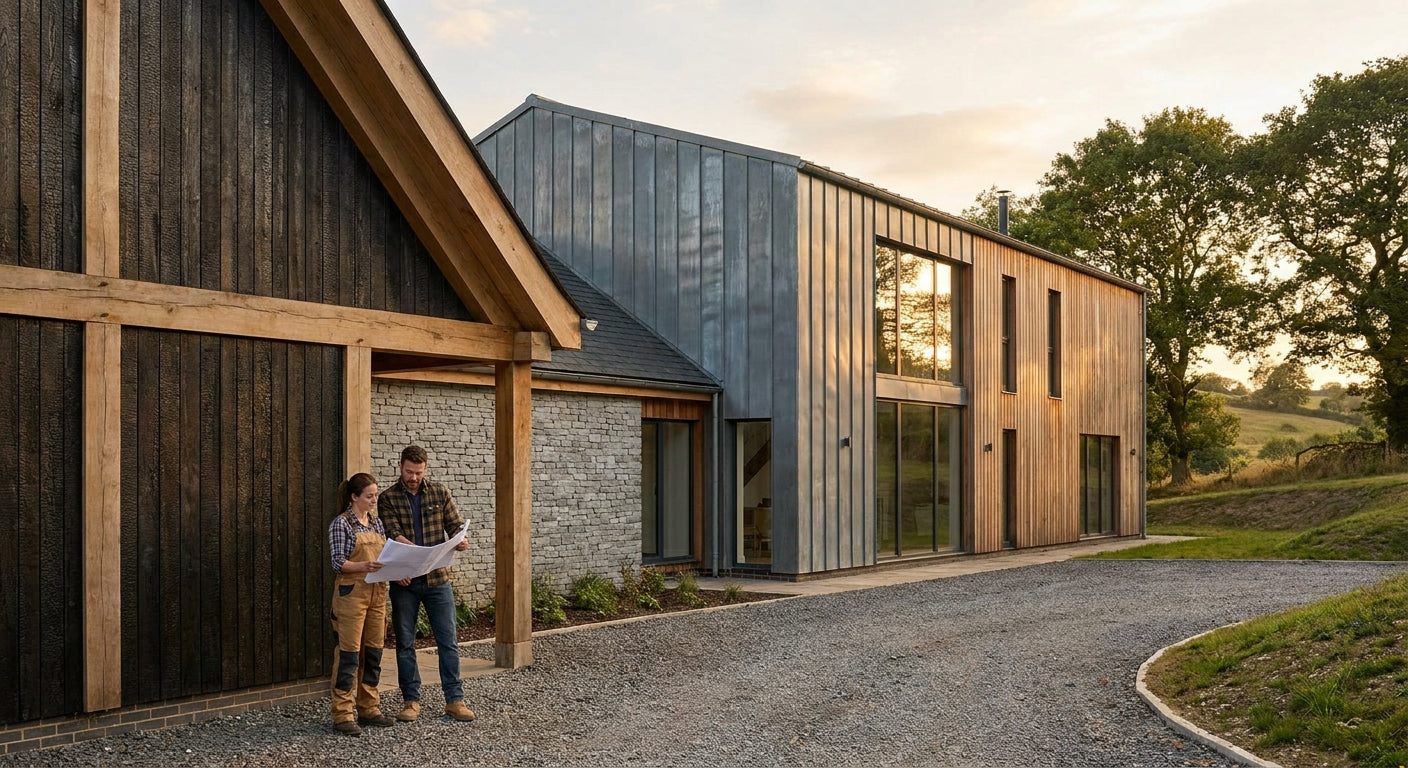
Choosing the right exterior cladding for a self-build home in 2026 is one of the decisions that shapes your project for decades — get it wrong and you're replacing panels within five years.
TL;DR: The best exterior cladding for self-build projects in 2026 combines weather resistance, low maintenance, and a finish that holds up to the UK's wet climate. Composite and engineered wood-effect panels outperform untreated timber on durability, and Akustiq UK's exterior cladding range — available in birch, oak, black, and stone grey — is purpose-built for exactly this use case. If you're at the materials stage of your self-build, order samples before you commit to a full panel run.
Why cladding choice matters more on a self-build
On a developer-built home, cladding is selected by committee and value-engineered down. On a self-build, you choose it once and live with that decision every day. The wrong pick doesn't just look bad — it fails building control sign-off, drives up maintenance costs, and can void your structural warranty.
Self-builders in 2026 face four specific pressures that make this choice harder than it looks:
- Timber frame structures (which account for the majority of UK self-builds) need cladding that allows the frame to breathe while keeping wind-driven rain out.
- Planning conditions frequently restrict colour, finish, and material type — especially in rural areas or near conservation zones.
- Budget constraints mean the cheapest option per panel often costs most over ten years in treatments and replacements.
- DIY installation is common on self-builds, so the panel system needs to be genuinely manageable without a specialist crew.
Who this guide is for
This guide is written for self-builders at the cladding-selection stage — you have your structural shell up or nearly up, you've got a rough elevation in mind, and you need to pick a panel system that passes inspection, fits your budget, and looks the way you imagined when you drew the plans. It also applies if you're cladding a substantial outbuilding, annexe, or garden studio as part of the wider project.
What to look for in exterior cladding for self-builds
Weather resistance
The UK averages over 1,200 mm of rainfall per year in many western regions. Any exterior cladding panel needs to shed water without warping, delaminating, or staining. Look for panels rated for outdoor exposure — not panels marketed as "weather-resistant" without a specification to back it up. Composite and engineered panels with a factory-applied finish hold their integrity far longer than site-oiled timber in wet climates.
Compatibility with timber frame
Timber frame buildings need a ventilated cavity between the structural frame and the cladding. The panel system you choose must work with a batten-and-void setup, typically 25–50 mm, to allow moisture to escape. Panels that fix directly to a membrane without any cavity are not suitable for timber frame — full stop. Check that the fixing system (screws, clips, or both) is specified for ventilated facade use.
Low maintenance requirements
Self-builders routinely underestimate ongoing upkeep. Natural timber cladding needs retreating every 2–3 years to stay weathertight. Composite panels with a factory finish typically need nothing more than an annual wash. Over a 10-year period, the labour and material cost of maintaining natural timber can exceed the original price difference between timber and composite. Factor that in before going "natural."
Fire performance
Building Regulations in England (Approved Document B) have tightened external wall fire requirements since the 2018 amendments. For buildings over 11 m, combustibility class matters significantly. For standard two-storey self-builds, the requirements are less restrictive, but your building control officer will want to see product data sheets. Always ask the supplier for the fire classification (Euroclass rating) before ordering.
Fixing system completeness
A common self-build mistake is pricing the panels without the fixings, trims, and corner pieces. These are not interchangeable between systems — a corner trim from one supplier rarely mates cleanly with another's panels. Choose a supplier that sells a complete system: panels, screws, finishing trims, and corner trims in matched finishes. Akustiq UK supplies all four components across each colourway, which removes the mismatched-finish problem entirely.
Finish and planning approval
If your planning permission specifies "natural timber effect" or "dark stained cladding", your panel choice must match that description in the planning documents. Stone grey, black wood grain, birch, and oak finishes cover the four most common planning-approved categories. Order physical samples — what looks right on a screen often reads differently on elevation at scale.
Top picks for self-build exterior cladding in 2026
The safe pick — Stone Grey
Hook: Neutral, planning-friendly, and works on rendered or masonry base walls.
Stone grey is the finish that passes planning conditions most reliably because it reads as neither aggressively modern nor conspicuously decorative. It suits both contemporary flat-roof designs and more traditional pitched-roof self-builds. The exterior wall cladding panel stone grey from Akustiq UK ships with matched screws, finishing trim, and corner trim — so every exposed edge is covered in the same finish.
Verdict: Buy — the default choice for self-builders who need to satisfy a planning officer and want zero maintenance arguments later.
The statement pick — Black
Hook: The finish most associated with contemporary self-build design in 2026.
Black cladding dominates self-build architectural photography right now, and for good reason — it reads as intentional and high-design against most landscaping. It works particularly well on timber frame structures where the dark finish accentuates clean lines. Order a sample outdoor wall panel black before committing — in direct sunlight and overcast northern light, black finishes can look very different, and you want to see it on your actual elevation.
Verdict: Buy if your planning conditions allow it. Hold if your site is in a conservation area or rural setting where dark finishes attract objections.
The warm-tone pick — Oak
Hook: The closest composite equivalent to natural timber, without the maintenance.
Oak-finish cladding gives the warmth and grain reference of natural wood while holding its colour without annual treatment. It suits self-builds that want a Scandinavian or organic aesthetic — particularly garden studios and annexes where the natural tone connects visually to surrounding planting. Pairs well with zinc or standing seam metal roofing.
Verdict: Buy for warm-aesthetic builds. Consider as a secondary material alongside black or stone grey for two-tone elevation treatments, which several UK planning authorities now actively encourage.
The light, fresh pick — Birch
Hook: The palest finish in the range — suits coastal and Scandinavian-influenced self-builds.
Birch reads almost white at distance, which makes it ideal for plots where you want to maximise visual light or where the planning brief asks for a pale, recessive finish. It also works internally for garden rooms and outbuilding interiors. Check the exterior wall cladding panel birch specification — it's the same engineered composite construction as the rest of the range, so weather resistance is equivalent.
Verdict: Buy for coastal, countryside, or Scandinavian-influenced projects. Consider for self-builders who want a pale finish that doesn't read as grey.
What to avoid
- Untreated or site-treated timber panels. Tempting on budget grounds, but factory-treated composite outperforms site-oiled timber within the first winter. The maintenance commitment is real, not theoretical.
- Panels sold without a complete fixing system. Buying panels from one supplier and sourcing screws or trims elsewhere almost always produces visual mismatches. The corner trim is the detail everyone notices on a finished elevation.
- Choosing finish from a screen without a physical sample. Colour and texture references vary dramatically between monitor calibrations and real-world light conditions. Every major decision on a self-build should involve a physical sample on the actual wall, in the actual orientation, at the actual time of day you'll see it most.
Comparison table
| Finish | Planning risk | Maintenance | Best for | Corner trim available |
|---|---|---|---|---|
| Stone Grey | Low | Annual wash | Neutral/modern builds | Yes |
| Black | Medium | Annual wash | Contemporary designs | Yes |
| Oak | Low | Annual wash | Warm/Scandinavian | Yes |
| Birch | Low | Annual wash | Coastal/pale aesthetic | Yes |
Where to buy
- Direct from Akustiq UK — order panels, matched screws, finishing trims, and corner trims together. All four colourways are in stock for UK delivery in 2026.
- Order samples first — every colourway has a sample panel available. At the self-build stage, this is non-negotiable before placing a full order.
- Check your panel count against your elevation drawings — Akustiq UK's panels ship in standard lengths; calculate your area coverage before ordering to avoid short deliveries mid-installation.
FAQ
What is the best exterior cladding for a self-build home in the UK? Composite or engineered wood-effect panels with a factory finish outperform untreated timber for self-builds in the UK's wet climate. Stone grey and oak finishes satisfy the widest range of planning conditions in 2026.
Does exterior cladding need planning permission on a self-build? Your self-build already has planning permission covering the elevations. If you change the specified cladding material or colour after approval, you may need a minor material amendment — check with your local planning authority before substituting a different finish.
Is composite cladding suitable for a timber frame self-build? Yes, provided the fixing system supports a ventilated cavity. Composite panels fixed over battens with a 25–50 mm void are compatible with timber frame construction and allow the structure to breathe.
How long does composite exterior cladding last? Well-specified composite cladding with a factory finish typically lasts 20–30 years with minimal maintenance. Annual washing is the main requirement — no oiling, staining, or retreating.
What fire rating do I need for self-build cladding? For standard two-storey self-builds in England, Approved Document B applies. Ask your supplier for the Euroclass fire rating on the product data sheet and confirm with your building control officer before installation.
Can I install exterior cladding myself on a self-build? Yes. Panel systems with a screw-fix or clip-fix method are manageable for a competent self-builder. The critical steps are accurate batten spacing, correct cavity sizing, and clean corner trim installation. See the how to install outdoor cladding on a brick wall guide for step-by-step detail.
How do I calculate how many cladding panels I need for my self-build? Measure your total elevation area in square metres, subtract window and door openings, then add 10% for cuts and waste. Panels come in standard lengths — check the coverage per panel in the product spec before ordering.
Which exterior cladding colour is easiest to get planning approval for? Stone grey and natural oak finishes attract the fewest planning objections in both urban and rural settings. Black cladding is accepted widely in 2026 for contemporary self-builds but can face resistance in conservation areas.
One last thing
The self-build detail most people overlook is the junction between cladding and window or door frames. If the finishing trim doesn't sit flush with your frame profile, the gap becomes a water ingress point — and water ingress at the frame-to-cladding junction is the single most common weathertightness failure on self-builds. Before you finalise your window specification, test-fit a section of trim against the actual frame profile. It takes ten minutes and can save a very expensive remediation job two winters later.
Share:
Best Composite Cladding for Coastal UK Homes 2026
Exterior Cladding Panels for Rendered Walls 2026