

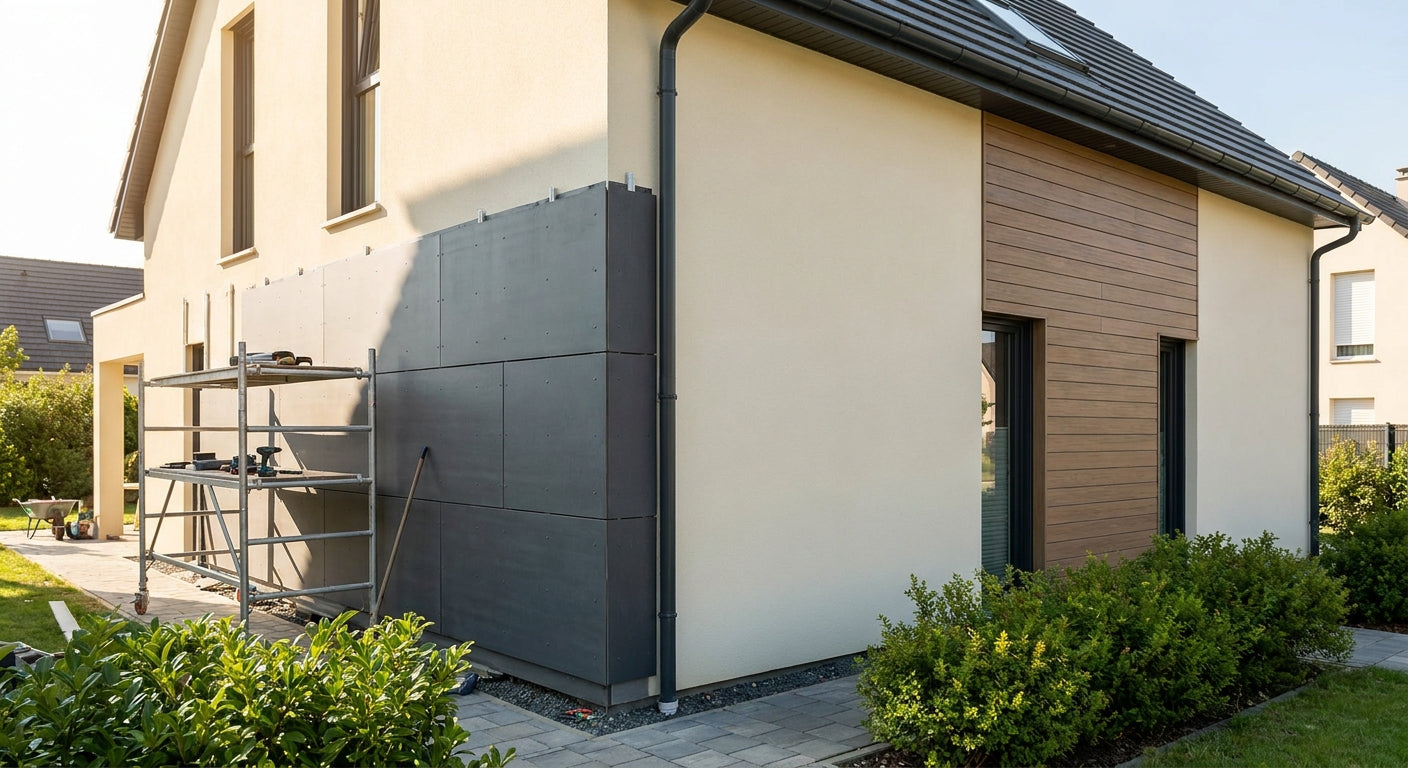
Rendered house walls give cladding something solid to work with — no flex, no movement, just a flat, stable substrate that lets panels sit flush and stay true. The challenge is picking exterior cladding panels for rendered walls that handle UK weather without warping, cracking the render, or looking tired within two seasons.
TL;DR: The best exterior cladding panels for rendered walls in 2026 are composite-core panels with a UV-stable surface, mechanical fixing via colour-matched screws, and a ventilated cavity behind the board. Akustiq UK's exterior wall cladding range — available in Birch, Oak, Black, and Stone Grey — is engineered for exactly this application. Order a sample before committing to a full run; rendered facades have very different light behaviour than photographed swatches suggest.
Why this matters
Render is everywhere on UK homes built between the 1920s and today, and the vast majority of owners who want to update the exterior are working with this substrate. Standard timber cladding boards absorb moisture and swell against render. Cheap composite boards UV-yellow within 18 months. The right panel solves both problems while adding real kerb appeal — and on a rendered house, the flat surface means installation is genuinely DIY-friendly once you understand the fix method.
Who this is for
This guide is for homeowners and self-builders with a rendered exterior wall — pebble-dash, sand-and-cement, or modern monocouche — who want to add cladding panels to a porch surround, front elevation, rear extension, or garden-facing side wall. It also applies to developers and contractors specifying exterior cladding panels for rendered walls on new-build or renovation projects. If you are working with a timber frame or brick substrate, some of the fixing advice differs, but the panel selection criteria are the same.
What to look for in exterior cladding panels for rendered walls
Material core
Composite-core panels — a blend of wood fibre and thermoplastic polymer — do not absorb moisture the way solid timber does. On a rendered wall, moisture trapped behind a swelling timber board is the fastest route to render delamination and mould. Composite panels hold their dimensions year-round, which is particularly important in the UK where a single winter can take an untreated timber board from tight to gapped.
UV and colour stability
Rendered walls are often fully exposed — no canopy, no overhang. A panel that fades from Black to grey-brown within two summers looks worse than bare render. Look for panels with a co-extruded cap layer or UV-stabilised pigment built into the surface, not just a surface coating. Akustiq UK's exterior cladding panels use a 3D wood-grain emboss with a UV-resistant cap, so the Black finish stays Black and the Stone Grey holds its tone rather than bleaching.
Fixing method compatibility
Render is not a structural substrate — you fix into the masonry behind it, not into the render face. The fixing system must accommodate the render thickness (typically 12–25 mm for sand-and-cement, up to 30 mm for monocouche) plus a ventilation batten (minimum 25 mm). Panels with pre-drilled pilot channels or concealed clip systems make this easier. Colour-matched screws are the practical choice for rendered walls where exposed fixings are visible from the street.
Ventilated cavity
This is non-negotiable on render. Moisture that condenses behind cladding needs somewhere to go. A 25 mm batten creating an air gap between render face and panel back allows airflow top to bottom, preventing the damp trap that causes render to bubble and spall. Any panel system that requires direct adhesive-only bonding to a rendered surface is unsuitable — the differential movement between render and panel will cause failure, usually within 2–3 years.
Panel dimensions and coverage
Larger panels reduce the number of horizontal joints visible on an elevation — important on a rendered house where the wall is a single plane and every joint reads clearly. Panels sized for maximum lineal coverage per board minimise waste on standard UK house-bay widths. Check the coverage figure (in m² per panel) against your measured wall area before ordering, adding 10% for cuts around windows, doors, and corners.
Colour fit with render colour
Most rendered UK houses are off-white, cream, or light grey. A cladding panel that blends into the render colour reads as an afterthought. The sharpest results come from contrast: Black or Stone Grey cladding on a white-rendered house, or Birch on a dark grey render. Oak sits in the middle — warm enough to contrast white render, calm enough not to compete with a terracotta or brick-red render.
Top picks
Black — the contrast choice
The bold pick. The exterior wall cladding panel black is the most-requested finish for rendered elevations in 2026, particularly on post-2010 new builds and rear extensions where a clean, high-contrast look is the brief. The 3D wood-grain emboss gives surface texture that reads as intentional rather than plastic at close range. Fix with matching black screws over a 25 mm batten onto the masonry behind the render — the Black cladding screws are sold separately and colour-match exactly.
Concrete verdict: if your render is white or light grey and you want a result that photographs well and ages well, this is the panel. Buy.
Stone Grey — the versatile middle ground
The safe pick. Stone Grey cladding sits between the drama of Black and the warmth of Birch. It works on rendered walls where the homeowner wants the texture and detail of cladding without a strong colour statement. Works particularly well on older rendered semis where a dramatic contrast might jar with neighbouring properties. Pair with the Stone Grey corner trim and finishing trim for a fully resolved junction at reveals and soffits.
Concrete verdict: the lowest-risk choice for planning-sensitive properties or homes with mixed-material surrounds. Buy.
Birch — warmth on a flat facade
The wildcard. Birch is a light, warm tone that reads as natural timber from the street without any of the maintenance demands of real wood. On a sand-and-cement rendered house, Birch breaks the monotony of flat white without going dark. The grain pattern is finer than Oak, which suits contemporary new-build renders better than period properties. Order a sample outdoor wall panel birch first — the warm undertone reads very differently in morning versus afternoon light on a north- versus south-facing elevation.
Concrete verdict: strong choice for front elevations where warmth is the goal; verify the tone in natural light before ordering full panels. Consider.
Oak — the natural-look option
The classic pick. Oak is the most recognisable grain pattern and the most forgiving on mixed-substrate elevations where cladding meets brick or stone at a boundary. It bridges old and new construction without forcing a contrast. On a rendered house, Oak reads as a deliberate material upgrade rather than a cover-up. The grain depth is more pronounced than Birch, which adds visual weight — useful on larger elevations where Birch might feel thin.
Concrete verdict: works on almost any rendered facade; the right answer when you want cladding to look like a considered material choice rather than a renovation patch. Buy.
What to avoid
- Direct adhesive bonding to render. Panel adhesive bonds to render, not to masonry. Render moves seasonally; the panel does not. Within 2–3 years this produces panel pop-off and render pulling away from the wall. Always batten out and fix mechanically.
- Untreated timber boards. Render holds moisture in the wall, and timber cladding directly over render wicks that moisture. The boards swell, cups, and splits. The render behind cracks as the boards pull at the fixings. Composite panels are the correct choice for this substrate.
- Panels without a matching trim system. A rendered house has window reveals, door frames, soffit edges, and external corners — all of which need a finished junction. Panels without purpose-made corner trims and finishing trims produce raw cut edges that collect dirt, allow water ingress, and look unfinished from two metres away. Specify trims at the same time as panels, not as an afterthought.
Comparison table
| Finish | Contrast vs white render | UV stability | Grain depth | Best for |
|---|---|---|---|---|
| Black | High | UV-capped | Medium 3D emboss | New builds, extensions, bold redesigns |
| Stone Grey | Medium | UV-capped | Medium 3D emboss | Period semis, planning-sensitive elevations |
| Birch | Low-medium | UV-capped | Fine | Contemporary new builds, south-facing elevations |
| Oak | Medium | UV-capped | Pronounced | Mixed-material elevations, traditional renders |
FAQ
Can you put cladding panels directly onto rendered walls? Not directly onto the render face. Fix timber battens (minimum 25 mm) through the render and into the masonry behind, then fix cladding panels to the battens. This creates the ventilated cavity the system needs and ensures fixings go into structural material, not into render.
What type of cladding is best for a rendered house? Composite-core panels with a UV-stable cap layer. Render retains moisture and presents a flat, rigid surface — composite panels match that rigidity without absorbing moisture the way solid timber does. In 2026, composite exterior cladding panels in finishes like Black, Stone Grey, Birch, and Oak are the standard specification for rendered UK homes.
Do I need planning permission to clad a rendered house? In most cases, no — cladding an existing rendered exterior falls under permitted development in England, provided the property is not in a conservation area, is not listed, and the cladding material is not stone, artificial stone, pebbledash, render, timber, plastic, or corrugated metal on a designated area property. Always check with your local planning authority before starting.
How long do composite exterior cladding panels last? Quality composite cladding panels with a UV-stable cap layer are typically rated for 25 years or more in outdoor UK conditions. The cap layer protects against UV degradation, the primary failure mode for composite products in temperate climates.
How do you fix cladding panels to a rendered wall? Fix 25 mm timber battens vertically to the masonry substrate through the render using appropriate masonry fixings. Space battens to match the panel fixing points — typically every 400–600 mm. Fix panels horizontally to the battens using colour-matched screws. Finish all edges, corners, and reveals with purpose-made trims.
Can exterior cladding panels go around windows on a rendered house? Yes. The key is using finishing trim pieces at the window reveal junction to create a clean, waterproof edge. Cut panels to within 5–10 mm of the window frame, then apply finishing trim over the cut edge. Seal the junction between trim and window frame with a UV-stable exterior silicone in a matching colour.
Is Stone Grey or Black cladding better for a modern rendered house? Both work — the choice is about elevation contrast and neighbourhood context. Black gives sharper contrast on white render and reads as more contemporary. Stone Grey is subtler and sits better in areas where neighbouring properties use lighter materials. Order samples of both and view them on the actual elevation at different times of day before deciding.
How much do exterior cladding panels cost for a rendered house? Cost depends on wall area, panel format, and the number of trim pieces required. Order accurate measurements — wall height multiplied by width, minus window and door openings — and add 10% for cut waste. Corner trims, finishing trims, and colour-matched screws are all specified separately and should be included in the initial order to avoid lead-time delays mid-install.
One last thing
Rendered walls amplify the colour of any material placed against them because render is almost always a neutral. A panel that looks mid-tone in a showroom or on a product photo will read noticeably lighter or darker on your actual elevation depending on which direction it faces and what time of day you look at it. Order at least one sample panel and hold it against your rendered wall at the time of day you care most about — early morning for east-facing elevations, late afternoon for west-facing ones. That 10-minute step prevents the single most common ordering regret in exterior cladding projects in 2026.
Share:
Exterior Cladding for Self Build Homes 2026 | Top Picks
Composite Cladding for Barn Conversions 2026