

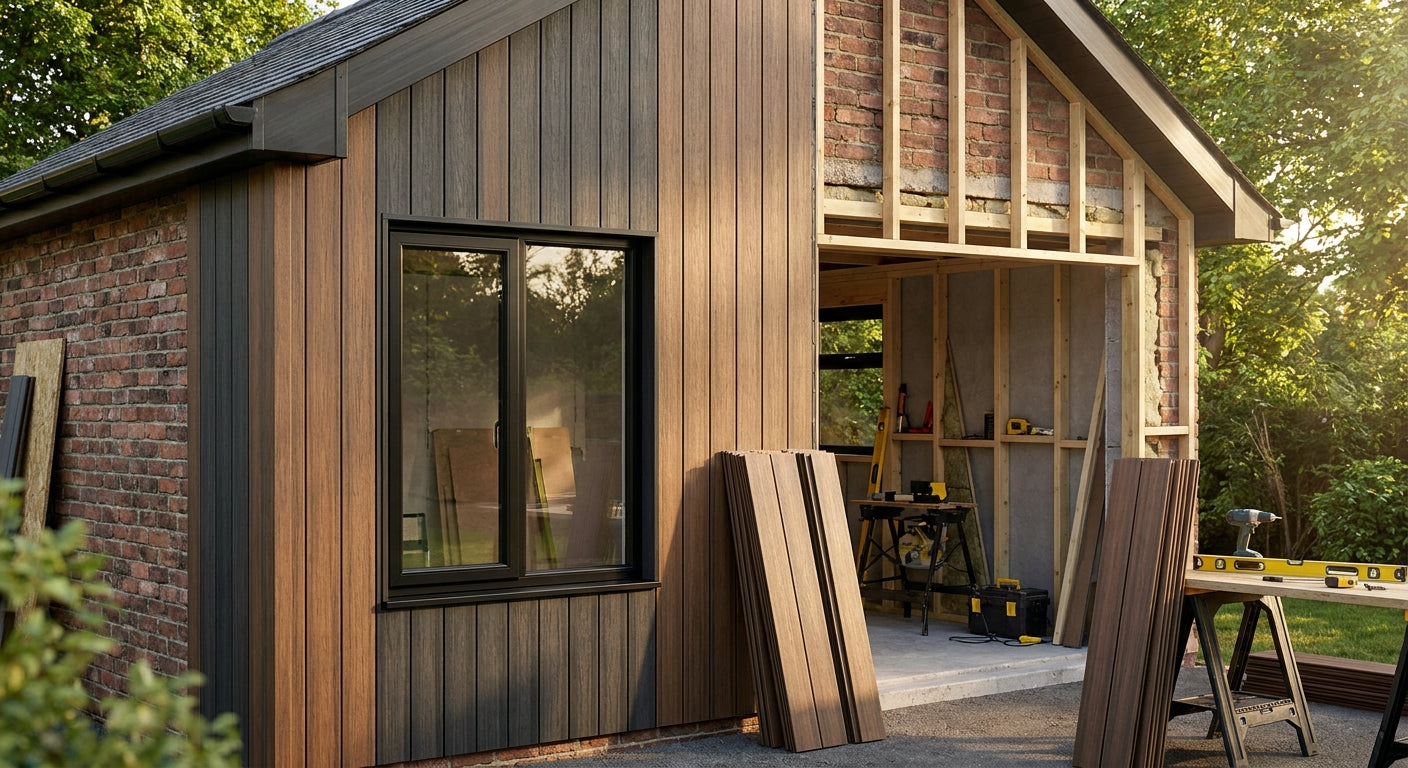
Garage conversions are one of the most cost-effective ways to add usable square footage to a UK home in 2026 — but the walls are the detail most people underestimate. This guide covers composite cladding for garage conversion walls: what the buyer profile looks like, which criteria actually matter, which panels are worth fitting, and what to avoid.
TL;DR: For a composite cladding garage conversion in 2026, the exterior-facing walls need a weatherproof, low-maintenance board that handles the UK's damp climate without warping or fading. Akustiq UK's exterior cladding panels — available in Birch, Oak, Black, and Stone Grey — are purpose-built for this application and ship direct to UK addresses. The interior walls are a separate decision: acoustic slat panels in Natural Oak or Smoked Oak tackle echo in converted rooms that double as offices, gyms, or studios. Order samples before you commit to full panels.
Why This Decision Matters in 2026
A garage conversion typically costs between £10,000 and £20,000 in the UK. The cladding choice on the external walls affects thermal performance, planning-permission optics, and resale value. Get it wrong and you're re-cladding within five years. Get it right and the finish is maintenance-free for a decade or more. The internal walls have a separate problem: garage-to-living-space conversions create hard, reflective surfaces that produce echo. Both decisions deserve proper treatment.
Who This Is For
This guide is written for UK homeowners who are part-way through a garage conversion — planning approved or permitted development confirmed — and are now choosing wall finishes. You're probably comparing composite cladding boards for the outside and deciding whether the interior walls need acoustic treatment. You may be managing a builder or doing some of the finish work yourself. You want panels that look clean in 2026, perform in the British climate, and don't require specialist installation.
What to Look for in Composite Cladding for a Garage Conversion
Weather Resistance
The external walls of a converted garage are exposed on at least two sides, often three. UK rainfall averages over 1,100 mm per year in western regions and the freeze-thaw cycle is punishing on materials that absorb moisture. A composite board must be moisture-resistant by construction — not just surface-treated. Look for boards rated for exterior use without additional sealing or annual maintenance.
Colour Stability
Fading is the most common complaint with cheaper composite boards. UV exposure causes pigment breakdown, and a board that looks sharp in 2026 can look washed-out by 2029. Choose boards with through-colour pigmentation rather than a surface coating, or products that are explicitly UV-stabilised. Stone Grey and Black finishes are particularly prone to showing fade if the board quality is poor.
Panel Size and Coverage Rate
Garage external walls typically run 2.4 m to 3 m in height. Boards that come in 240 cm or 300 cm lengths minimise horizontal joins, which reduces both the visual busyness and the number of potential water ingress points. Calculate your square metreage before ordering and account for 10% waste on cuts around windows, doors, and soffits.
Interior Acoustic Performance
Once you've dealt with the external skin, the interior is a different challenge. A converted garage used as a home office, gym, or cinema room will have hard walls, a concrete or screed floor, and no soft furnishings initially — all of which cause echo and reverberation. Acoustic slat panels with a felt backing address this directly. Panels with a 3-sided real wood veneer finish look premium while the felt backing absorbs mid-frequency sound that bare plasterboard reflects.
Ease of DIY Installation
Not every garage conversion owner wants a second contractor on site. Boards that clip, screw, or glue to an existing substrate — timber batten, masonry, or timber frame — without specialist tools are worth paying attention to. Check whether the product includes matching screws, corner trims, and finishing trims in the same colour family so the finished edges are clean.
Finish Consistency Across the Build
A common mistake is choosing the exterior cladding in isolation from the interior wall finish. If your exterior is Black and your interior slat panels are Natural Oak, the contrast can work — but it needs to be intentional. Order physical samples of both before you buy full panels. Viewing colours on a screen in different lighting conditions is unreliable.
Top Picks for a Garage Conversion in 2026
Exterior Walls: Black Cladding Panel
The bold, low-maintenance pick. Black composite exterior cladding is the most-requested finish for garage conversions in 2026 because it reads as deliberately architectural rather than as an afterthought. Through-colour pigmentation means chips and scratches are less visible than on lighter finishes. Matches timber frame constructions and rendered elevations equally well.
Verdict: Buy if the property is a modern or post-1990 build, or if neighbouring conversions have already set a contemporary tone on the street. See the exterior wall cladding panel black for specifications and sizing.
Exterior Walls: Stone Grey Cladding Panel
The safe pick for planning-sensitive streets. Stone Grey reads as neutral and sits comfortably next to render, brick, and white UPVC windows — the most common combination in UK semi-detached and terraced housing. It is the lowest-risk choice if your property is in a conservation area or if the permitted development conditions restrict cladding colours.
Verdict: Buy for period or traditional streetscapes. Exterior wall cladding panel stone grey ships with matching finishing trims available separately.
Interior Walls: Natural Oak Acoustic Slat Panel
The versatile interior pick. Natural Oak is the most adaptable wood finish for a converted garage interior because it works with white, grey, and concrete colour schemes without dominating. The 3-sided real wood veneer finish means the panel looks finished even when the skirting or cornice hasn't been fitted yet. The acoustic felt backing reduces mid-frequency reverberation — relevant if the room will be used as an office or gym where speech clarity matters.
Verdict: Buy for most conversion interiors in 2026. Order a sample wooden wall panel natural oak before committing to full panels.
Interior Walls: Smoked Oak Acoustic Slat Panel
The character pick. Smoked Oak reads darker and warmer than Natural Oak — well-suited to a cinema room, bar, or gaming space where the aim is atmosphere rather than brightness. The same acoustic felt backing applies. Works particularly well floor-to-ceiling on the longest wall of the conversion.
Verdict: Consider if the room has a leisure or entertainment function. Strong choice for a conversion that will be marketed as a premium feature at resale.
Accessories: Corner and Finishing Trims
The detail that separates a professional finish from an amateur one. Matching corner trims and finishing trims prevent exposed raw edges at window reveals and door frames. Available in Birch, Oak, Black, and Stone Grey to match the cladding boards. Budget for these at the outset — retrofitting trims after the boards are fixed is slower and more expensive.
Verdict: Buy alongside the boards, not as an afterthought.
Comparison Table
| Panel | Application | Colour Options | Acoustic Felt | DIY-Friendly |
|---|---|---|---|---|
| Exterior Cladding — Black | External walls | Black | No | Yes |
| Exterior Cladding — Stone Grey | External walls | Stone Grey | No | Yes |
| Natural Oak Slat Panel | Interior walls | Natural Oak | Yes | Yes |
| Smoked Oak Slat Panel | Interior walls | Smoked Oak | Yes | Yes |
| Corner and Finishing Trims | Edges and reveals | Matches cladding | N/A | Yes |
What to Avoid
1. Using interior panels on external walls. The acoustic slat panels are designed for indoor use. The real wood veneer will degrade when exposed to driving rain and frost. Only the exterior cladding range — clearly marked in the product names — is rated for external UK conditions.
2. Skipping the sample stage. Screen colours are not reliable for cladding. A Black board in bright showroom lighting looks different from a Black board on a north-facing garage wall in January. Akustiq UK supplies samples for all exterior cladding colours. Use them.
3. Buying boards without the matching fixings and trims. Generic screws leave visible rust marks within 18 months on exterior applications. Matching screws in the same colour family are available for all exterior cladding boards — Birch, Oak, Black, and Stone Grey — and the difference to the finished appearance is significant. See the range of exterior cladding screws black as an example of what a properly matched fixing looks like.
FAQ
What is the best composite cladding for a garage conversion exterior in the UK? Black and Stone Grey are the two most-used finishes for UK garage conversions in 2026. Black suits modern builds; Stone Grey works better on traditional or period streetscapes. Both need UV-stabilised composite construction to prevent fading.
Can I use the same cladding on interior and exterior garage conversion walls? No. Exterior composite cladding is moisture-resistant and UV-stabilised. Interior acoustic slat panels use real wood veneer and acoustic felt — materials not rated for outdoor exposure. Use the exterior range outside and the interior slat panel range inside.
Do I need planning permission to clad the exterior of a converted garage in the UK? In most cases, re-cladding an existing garage that is being converted falls under permitted development, but the specific colour and material can be restricted in conservation areas or by Article 4 directions. Check with your local planning authority before ordering.
How much cladding do I need for a garage conversion? Measure the total external wall area in square metres, subtract window and door openings, then add 10% for waste on cuts. A standard single garage with three external elevations typically requires 30–45 m² of cladding.
Are acoustic wall panels worth fitting inside a converted garage? Yes, if the room will be used as an office, gym, cinema room, or studio. A concrete-floor, plasterboard-wall room with no soft furnishings produces significant reverberation. Acoustic slat panels with felt backing reduce this without requiring specialist soundproofing treatment.
How do I fit exterior composite cladding on a timber frame garage conversion? Fix horizontal or vertical battens to the frame at 400–600 mm centres, then fix the cladding boards to the battens using the matching colour screws. Start at the bottom and work up, overlapping each board per the manufacturer's specification. Use corner trims at all external corners and finishing trims at window and door reveals.
Is composite cladding low maintenance on a UK garage conversion? Yes — a quality composite board requires no painting, staining, or sealing. Wash down with water annually to remove algae and dirt. Avoid abrasive cleaners on pigmented surfaces.
What wood finish works best for the interior of a garage conversion office? Natural Oak is the most practical interior choice for a home office conversion in 2026: it reads as light and neutral, improves perceived ceiling height, and the acoustic felt backing reduces echo that affects call quality and concentration.
One Last Thing
The biggest cost in a garage conversion is always time — builder schedules slip, deliveries land late. Ordering exterior cladding and interior acoustic panels at the same time, with samples confirmed before the order, is the one step that consistently prevents a two-week delay at first-fix stage. Both product ranges ship direct from Akustiq UK.
Share:
Best Cladding Panels for Garden Office Exteriors 2026
Composite Cladding Panels for Extensions 2026