

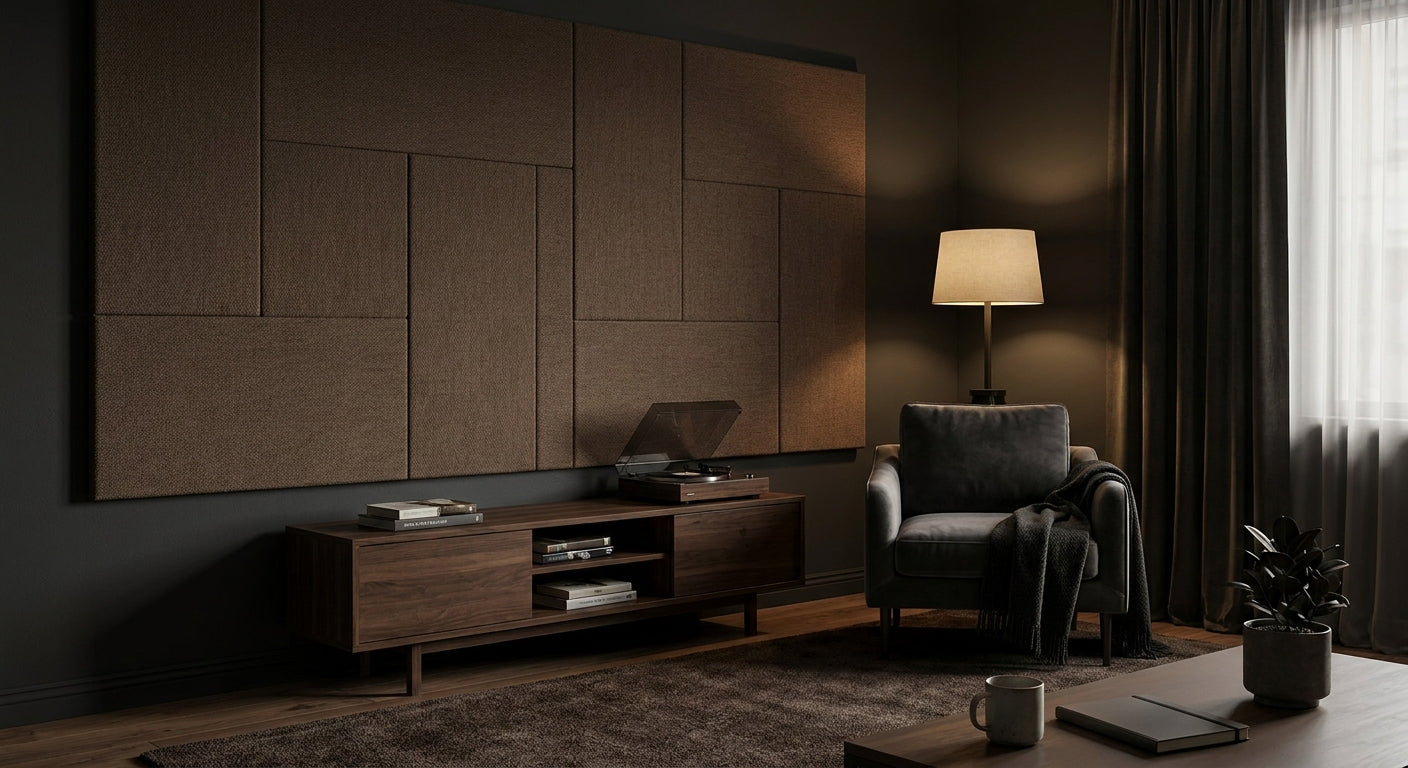
Mocca acoustic wall panels sit in a narrow sweet spot — warm enough to soften a dark interior, deep enough to disappear into it rather than fight it. This guide covers the best mocca acoustic wall panels available in 2026, ranked for dark-toned rooms where colour, grain, and sound absorption all need to pull their weight.
TL;DR: The best mocca acoustic wall panels for dark-toned interiors in 2026 combine a rich brown-black finish with a perforated or slatted acoustic core that genuinely reduces echo. Akuwoodpanel.uk's Wooden Wall Panel Mocca is the strongest single-panel pick — it pairs natural wood veneer with a felt acoustic backing and sits directly in the dark-interior colour range without needing a companion finish. For rooms where contrast matters, the Black Oak option extends the palette without breaking the scheme.
Why This Matters
Dark-toned interiors are unforgiving of mismatched materials. A panel that reads as "brown" in a showroom can look muddy against charcoal plaster or flat black joinery. Mocca as a finish occupies the warm end of the dark-wood spectrum — think espresso, aged walnut, smoked tobacco — and it works precisely because it adds depth rather than brightness. In 2026, more UK homeowners and commercial fit-out teams are pairing dark walls with acoustic treatment rather than treating sound as an afterthought. The challenge is finding panels that satisfy both the acoustic brief and the visual brief simultaneously.
How We Ranked
Every panel on this list was assessed against four criteria relevant to dark-toned interiors specifically:
- Finish accuracy — does the mocca or dark-wood tone hold up against deep wall colours (charcoal, anthracite, racing green, navy)?
- Acoustic performance — does the panel use a genuine sound-absorbing substrate (felt, foam, mineral wool) rather than a decorative-only backing?
- Veneer or finish quality — is the facing a real wood veneer, engineered veneer, or printed film? Real and engineered veneers age better under artificial lighting, which dominates dark interiors.
- Installation practicality — tongue-and-groove, clip systems, and direct-adhesive options all affect whether panels can go on plasterboard without specialist labour.
Panels are ordered by overall fit for a dark-toned brief. Where a panel excels in one area but has a clear trade-off, that trade-off is named.
The Ranked List
1. Wooden Wall Panel Mocca — The Benchmark Pick
Hook: The safe pick for dark interiors in 2026.
Akuwoodpanel.uk's Wooden Wall Panel Mocca uses a natural wood veneer face over an acoustic felt backing. The mocca finish sits in the warm-dark range — close to an aged walnut stain — which means it absorbs ambient light rather than reflecting it, keeping the moody quality of a dark room intact. The felt backing provides genuine mid-frequency sound absorption, making this a functional acoustic panel rather than a decorative slat with a dark stain. Installation uses a standard tongue-and-groove system compatible with plasterboard substrates.
Why now: Dark maximalist interiors are the dominant residential trend in UK interior design in 2026. Panels that were specified for smoked-oak or charcoal schemes a year ago are now being re-ordered in mocca specifically because designers want warmth inside a dark palette rather than cool grey.
Verdict: Buy. This is the primary recommendation for any dark-toned room where acoustic treatment is part of the brief.
2. Wooden Wall Panel Black Oak — The Cooler Alternative
Hook: The pick when mocca reads too warm for your specific scheme.
The Wooden Wall Panel Black Oak from Akuwoodpanel.uk moves the palette toward cool-dark rather than warm-dark. Black oak finishes sit closer to charcoal and anthracite on the colour spectrum, which makes this panel the stronger choice in rooms with cool-toned walls, polished concrete floors, or blue-grey joinery. The acoustic construction is comparable to the mocca version — felt-backed slat panel — so sound absorption characteristics are consistent across both finishes.
The trade-off: in warmer dark rooms (deep burgundy, forest green, aged copper accents), black oak can feel flat. Mocca does more tonal work in those environments.
Verdict: Buy for cool dark schemes. Hold if your walls are warm-toned.
3. Wooden Wall Panel Rustic Oak Premium 3-Sided Veneer — The Texture Statement
Hook: The wildcard — technically lighter in tone, but the right move for layered dark schemes.
The Wooden Wall Panel Rustic Oak Premium 3-Sided Wood Veneer is a departure from the mocca palette, but it earns its place on this list. The three-sided veneer construction wraps all visible faces, which gives slatted walls a genuine depth that painted or film-finish panels cannot replicate. In a dark interior, this texture reads as shadow and grain rather than light wood — especially under warm directional lighting, which is standard in residential dark-scheme rooms.
The rustic oak tone is lighter than mocca, so this panel works best as a contrast element — a chimney breast or alcove feature — rather than a full-room installation in a dark scheme. Used at 20–30% of total wall area against mocca or black oak, it prevents a room from becoming visually heavy.
Verdict: Consider as an accent panel. Skip if you want tonal consistency across all four walls.
4. Exterior Wall Cladding Panel Black — The Commercial Grade Option
Hook: Not a traditional acoustic panel, but the right answer for high-traffic dark interiors.
The Exterior Wall Cladding Panel Black is specified for exterior use, which means it is built to a higher durability standard than interior acoustic panels. In dark-toned commercial interiors — bars, restaurant fit-outs, retail — where walls take physical contact and the visual brief demands a genuine black rather than a dark brown, this panel delivers what interior-only products cannot. The black finish is consistent and does not fade under the UV output of track lighting, which is a real problem with some interior-only dark finishes after 12–18 months.
Acoustic performance is secondary here — this is a cladding product, not a felt-backed absorber. Pair it with acoustic ceiling treatment or a separate absorber panel if sound control is part of the brief.
Verdict: Consider for commercial dark interiors. Skip if residential acoustic performance is the primary requirement.
What to Avoid
- Printed-film dark finishes. Several UK suppliers sell panels with a dark-wood photographic film over MDF. Under the artificial lighting typical in dark-toned rooms, film finishes read as flat and slightly glossy, which breaks the visual coherence of a high-spec dark interior. Real or engineered veneer is the correct specification.
- Purely decorative slat panels without a backing substrate. A slatted panel with no felt or foam backing does nothing acoustically. It will scatter some sound, but scattering is not the same as absorption. If echo or reverberation is part of the brief, confirm the panel includes a sound-absorbing layer before ordering.
- Panels specified for a single wall in a dark room without calculating total coverage. Acoustic panels need to cover a meaningful proportion of total room surface area to affect reverberation time — typically 20–25% of combined wall and ceiling area. One feature wall of mocca panels in an otherwise hard-surfaced dark room will look good and sound the same as before.
Comparison Table
| Panel | Finish Tone | Acoustic Backing | Veneer Type | Best Use Case | Verdict |
|---|---|---|---|---|---|
| Wooden Wall Panel Mocca | Warm dark brown | Felt | Natural wood veneer | Full-room dark interiors | Buy |
| Wooden Wall Panel Black Oak | Cool dark/charcoal | Felt | Wood veneer | Cool-toned dark schemes | Buy / Hold |
| Rustic Oak Premium 3-Sided Veneer | Mid-light rustic oak | Acoustic core | 3-sided real veneer | Accent walls in dark rooms | Consider |
| Exterior Cladding Panel Black | True black | None (cladding) | Composite/engineered | Commercial, high-traffic | Consider |
Where to Buy
- Direct from manufacturer: Akuwoodpanel.uk manufactures and supplies all panels listed. Ordering direct gives access to the full range, sample service, and consistent batch matching — important when covering large wall areas where colour consistency across panels matters.
- Order samples before committing to full coverage. Mocca finishes vary between manufacturers. A sample under your specific lighting conditions (warm LED, directional spots, or natural light from limited windows) is the only reliable way to confirm the finish works in your room.
- Check batch availability for large projects. For commercial fit-outs or whole-room residential installations, confirm stock levels before specifying — dark-finish panels in popular tones can have lead times of 2–4 weeks in 2026 when demand is high.
FAQ
What are the best mocca acoustic wall panels for dark interiors in 2026? The Wooden Wall Panel Mocca from Akuwoodpanel.uk is the strongest option — it uses a natural wood veneer face with a felt acoustic backing, and the warm-dark mocca tone works directly against charcoal, navy, and deep green walls without needing an additional finish layer.
Is mocca darker than smoked oak? Mocca sits in the warm-dark range — closer to espresso or aged walnut — while smoked oak typically reads as a cooler grey-brown. In most dark interiors, mocca adds warmth; smoked oak reads as more neutral or slightly cool.
Do acoustic wall panels actually reduce noise in a dark room? Yes, provided they include a genuine absorbing substrate. Felt-backed panels like the Wooden Wall Panel Mocca absorb mid-frequency sound, which reduces echo and reverberation. Coverage area matters: 20–25% of total wall and ceiling surface is the practical minimum to hear a difference in a standard UK room.
Can mocca wall panels go in a room with dark ceilings? Yes — in rooms where walls, ceilings, and floors are all dark, mocca panels add grain and texture that prevents the space from feeling flat. Pairing mocca wall panels with an acoustic ceiling treatment addresses both sound and visual weight simultaneously.
How many panels do I need to cover a feature wall? This depends on panel dimensions and wall area. Calculate total square meterage of the wall, then divide by the individual panel coverage area. Akuwoodpanel.uk's panels are specified with individual dimensions — check the product page for exact coverage figures before ordering.
Are dark acoustic panels suitable for commercial fit-outs? Yes. Mocca and black oak panels are used in bars, restaurants, hotel lobbies, and office interiors across the UK in 2026. For high-traffic commercial environments, prioritise panels with durable face finishes and consider the exterior-grade cladding option for walls at standing height.
What is the difference between a mocca panel and a black oak panel acoustically? Acoustically, both use comparable felt-backed constructions and perform similarly. The difference is purely in finish tone — mocca is warm dark brown, black oak is cool dark/charcoal. Choose based on your wall colour and lighting temperature, not acoustic performance.
Can I mix mocca panels with other dark finishes in the same room? Yes — mixing mocca with black oak or a rustic oak accent is a standard approach in 2026 dark-interior design. Keep the darker tone (black oak) on larger surfaces and use mocca or rustic oak on feature walls or alcoves to create depth without visual chaos.
One Last Thing
The single most common mistake with dark acoustic panels is treating the colour decision and the acoustic decision as separate. In practice, the finish you choose determines whether the room feels intentional or accidental. Mocca works in dark interiors specifically because it sits at the boundary between wood and shadow — it is visible as a material without competing with the wall colour. That is a harder balance to achieve than it looks, and it is why mocca remains one of the most-specified dark acoustic finishes for residential and commercial projects in the UK in 2026.
Share:
Mocca Veneer Panels for Home Office Walls 2026
How to Style Mocca Wall Panels — 2026 Guide