

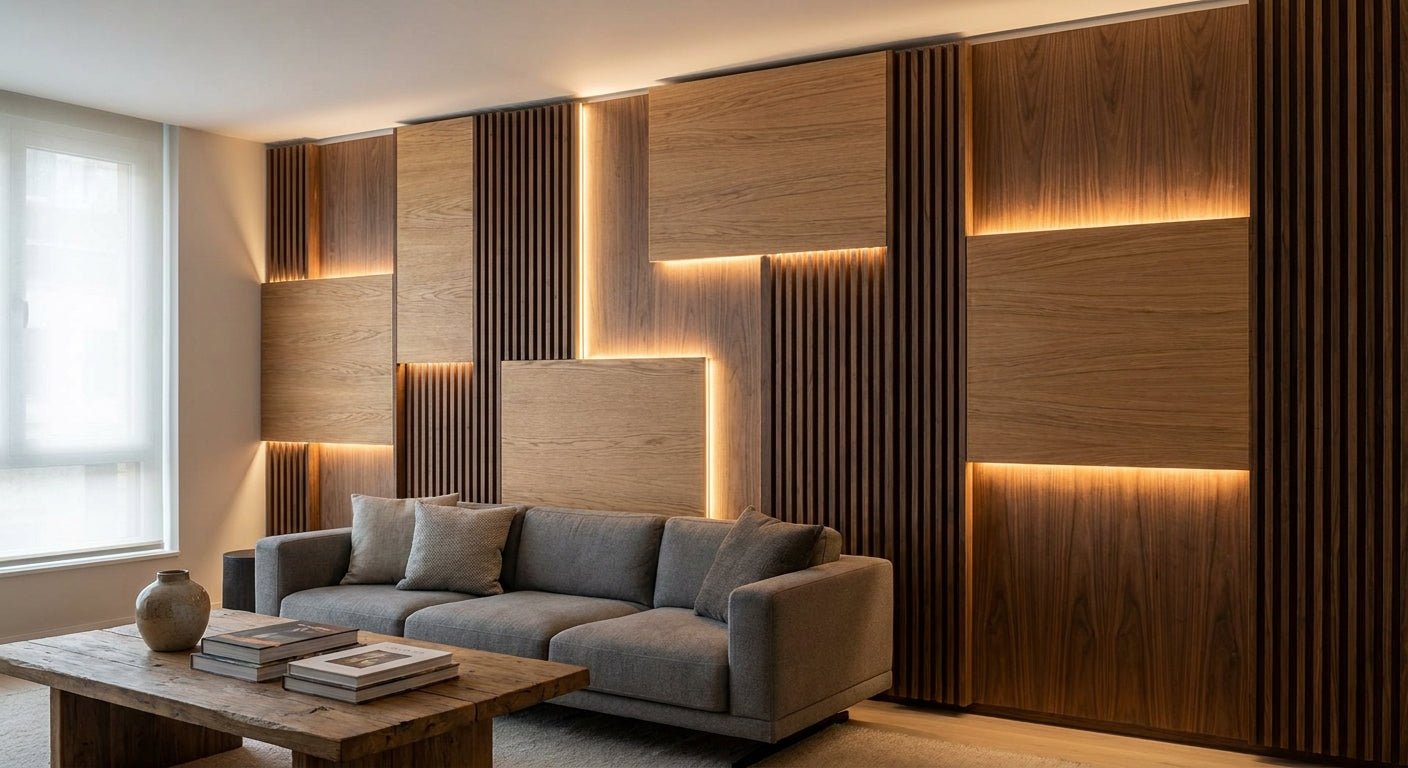
Wooden wall panels with LED lighting combine two of the most-requested interior upgrades into a single installation — and the result looks far more expensive than either element costs alone. This guide covers who this pairing works best for, the criteria that separate a polished finish from a frustrating retrofit, and which Aku Wood Panel finishes perform best when light runs behind or in front of the slats.
TL;DR: Wooden wall panels with LED lighting suit homeowners and interior designers who want a feature wall with depth, warmth, and controlled ambience in 2026. Slatted acoustic panels — particularly natural oak and smoked oak — are the most forgiving formats for LED channel integration. Black oak delivers the sharpest contrast under directional strip lighting. Order a sample before committing to a full wall.
Why this pairing works in 2026
LED strip lighting costs roughly 60–80% less to run than halogen equivalents at equivalent lumen output. Pair that with acoustic wood slat panels — which already break up a flat wall surface with shadow lines — and you get a wall that creates its own depth without any additional decorative work. The slat grooves act as natural channels for LED strips, and the wood grain scatters light in a way that painted drywall or MDF simply cannot replicate. In 2026, this combination has moved firmly from hospitality interiors into residential feature walls, home offices, and home cinema rooms.
Who this is for
This guide is written for homeowners renovating a living room, bedroom, or home office feature wall; interior designers specifying a statement wall for a residential or light commercial project; and self-builders who want an acoustic benefit alongside the visual upgrade. If you are fitting panels behind a TV wall, adding LED backlighting, or trying to warm up a north-facing room that gets little natural light, you are the exact audience this pairing is built for.
What to look for in wooden wall panels for LED lighting
Slat spacing and groove depth
The gap between slats is where your LED strip lives. Panels with a groove depth of at least 10 mm give you enough clearance to run a 5 mm or 8 mm LED channel without the strip sitting proud of the surface. Shallow grooves force the strip to the front face, which creates hotspots rather than diffused glow. Check the product spec sheet before ordering — not every slatted panel is designed with cable management in mind.
Finish and light reflectance
Lighter finishes — natural oak, grey oak — bounce LED light further along the wall, softening the overall effect. Darker finishes — smoked oak, black oak, mocca — absorb more light and produce a tighter, more dramatic pool of illumination around each strip. Neither is wrong; they produce categorically different moods. A natural oak wall panel in a bedroom reads as calm and warm under 2700 K warm white LEDs. A black oak wall panel in a home cinema reads as cinematic and high-contrast under the same light source.
Acoustic performance
Slatted panels backed with felt absorb mid-to-high frequency sound. If your LED feature wall is in a room with hard floors and bare ceilings — a common combination in open-plan living spaces — the felt-backed variants do double duty: they manage echo at the same time as framing your lighting. Panels without felt backing still deliver the visual effect but contribute nothing acoustically. For a home cinema or music room, felt-backed panels are the obvious choice.
Surface treatment and heat tolerance
LED strips running continuously generate low but consistent heat. Real wood veneer panels are stable at the operating temperatures of modern LED strips (typically under 45°C on the strip surface), but check that any lacquer or oil finish on the panel face is heat-tolerant if you plan to mount strips directly on the wood face rather than inside the groove. Aku Wood Panel's acoustic slat panels use a treated veneer that handles standard LED strip operating temperatures without discolouration.
Panel format — slat vs decorative 3D
Slatted panels are the natural fit for LED integration because the groove runs the full height or width of the panel, giving you a continuous channel. Decorative 3D panels (Lobelia, Aster, Snowdrop, Crimson, Gardenia formats) work with point-source lighting rather than strip lighting — a directional spotlight at 30–45 degrees from the wall surface creates deep shadows in the relief pattern. These panels reward LED spotlights or adjustable downlights, not strip lighting behind the slats.
Sample first
Colour temperature of LEDs changes how a finish reads dramatically. A natural oak panel looks golden under 2700 K and clinical under 6500 K. Order a physical sample and hold it under your chosen bulb temperature before committing to a full wall. At the price point of a feature wall installation, a £3–5 sample is the cheapest insurance available.
Top picks for LED lighting installations
Natural Oak — the safe pick
Hook: The most forgiving finish for first-time installations. Natural oak's mid-tone grain diffuses LED strip light evenly, minimising hotspots even when strips are spaced 400 mm apart. Works with warm white (2700–3000 K) and neutral white (4000 K) without looking washed out. Verdict: Buy for living rooms, bedrooms, and hallways where warmth is the priority. See the wooden wall panel natural oak for full specs.
Black Oak — the high-contrast pick
Hook: The right choice when you want the LED to do the talking. Black oak absorbs ambient light and makes strip LEDs appear brighter by contrast — even a modest 600-lumen strip reads as dramatic against the dark slat face. Best suited to home cinemas, bar areas, and feature walls where you want the illuminated panel to be the focal point of the room. Verdict: Buy for dark-finish schemes and cinematic feature walls.
Smoked Oak — the middle ground
Hook: Sits between natural oak's warmth and black oak's drama. The grey-brown tone reads well under both warm and cool LED temperatures, making it the most flexible finish when the lighting spec is not yet locked in. Particularly effective on chimney breast feature walls where the panel runs floor-to-ceiling and the LED strip is recessed into the groove. Verdict: Buy for undecided schemes or mixed-use rooms.
Natural Oak with Grey Felt — the acoustic-first pick
Hook: For rooms where echo control matters as much as aesthetics. The grey felt backing adds sound absorption without changing the front-face appearance. If your feature wall is in a home office, open-plan kitchen-diner, or music room, this variant handles both briefs simultaneously. Verdict: Buy when the room has parallel hard surfaces and you need acoustic attenuation alongside the visual effect.
Rustic Oak Premium 3-Sided Wood Veneer — the premium wildcard
Hook: The 3-sided veneer construction means cut ends and revealed edges are finished to the same standard as the face — critical if your LED installation exposes panel ends (for example, a floating panel installation with a gap between the panel and the ceiling). At standard slatted panel prices, exposed cut ends look raw; this format does not have that problem. Verdict: Consider for bespoke or exposed-edge installations where finish quality at every angle matters.
What to avoid
- High-gloss or lacquered panels with LED strips in the groove. Gloss surfaces reflect the LED point source directly, creating visible hotspots every 50–100 mm along the strip. Matte or satin-finished panels diffuse the light; gloss panels reveal it.
- Skipping the end piece. Slatted panels without a finished end piece leave the panel substrate exposed at the wall edge. Under LED lighting, any revealed substrate telegraphs immediately because the light grazes the wall surface. Aku Wood Panel supplies matching end pieces for each finish — use them.
- Cold white LEDs (5000 K+) against warm wood tones. Cold white light turns natural oak panels grey and drains warmth from walnut finishes. Unless you are specifically chasing an industrial aesthetic, stay at 2700–4000 K for wood-panel installations.
Comparison table
| Finish | Light reflectance | Best LED temp | Acoustic felt option | Best room type |
|---|---|---|---|---|
| Natural Oak | High | 2700–4000 K | Yes | Living room, bedroom, hallway |
| Black Oak | Low | 2700–3000 K | No | Home cinema, bar, feature wall |
| Smoked Oak | Medium | 2700–4000 K | Yes | Any mixed-use room |
| Nat. Oak Grey Felt | High | 2700–4000 K | Yes (included) | Home office, open-plan, studio |
| Rustic Oak Premium | Medium-high | 2700–3000 K | No | Bespoke / exposed-edge installs |
FAQ
What are wooden wall panels with LED lighting? Slatted wood panels installed on a wall surface with LED strip lights run inside the grooves between slats or behind the panel face. The slat gaps act as natural light channels, producing a diffused glow across the wall surface.
Which wood panel finish is best for LED backlighting? Natural oak is the most forgiving — its mid-tone grain diffuses strip lighting evenly. Black oak gives the highest contrast for a dramatic effect. Smoked oak sits between the two and works across the widest range of LED colour temperatures.
Can I fit LED strips myself behind acoustic wood panels? Yes. Most slatted acoustic panels are compatible with self-adhesive LED strips in the 5–8 mm width range. The groove between slats is the channel; the strip adheres to the backing board. No specialist tools are required beyond a mitre saw for panel cuts and a tape measure.
What LED colour temperature should I use with wood panels in 2026? 2700 K (warm white) suits natural oak, walnut, and smoked oak in residential rooms. 3000–4000 K works in home offices where task visibility matters. Avoid anything above 4000 K unless you want a deliberately cool, contemporary aesthetic.
Do wooden wall panels with LED lighting improve acoustics? Slatted panels with felt backing absorb mid-to-high frequencies and reduce echo. The LED lighting has no acoustic effect; the panel construction does. If acoustic performance matters, specify a felt-backed variant.
How much wall area do I need for the effect to work? A single feature wall — typically 3–4 m wide and 2.4 m high — is sufficient. Smaller feature walls of 1.5–2 m width still work but benefit from a tighter LED strip spacing (200–300 mm centres rather than 400 mm) to avoid the effect looking sparse.
Are wood panels safe near LED strip lighting? Yes. Modern LED strips run at surface temperatures well below the threshold that would affect treated wood veneer or panel backing boards. Avoid placing strip connectors or drivers directly against the panel face and ensure adequate ventilation behind any enclosed panel cavity.
Is it better to run LED strips vertically or horizontally behind slatted panels? Horizontally along the slat groove is the standard approach for slatted panels — the groove provides a continuous channel. Vertical runs work on flat-face panels but require careful planning to avoid the strip crossing the face veneer.
One last thing
The single most common mistake in LED panel installations in 2026 is choosing the panel finish before choosing the LED colour temperature. The wood does not look the same under every light source — natural oak under 6500 K looks like a different product from natural oak under 2700 K. Order the sample wooden wall panel natural oak or the equivalent finish sample, hold it under your actual fitting in the actual room, and make the colour temperature decision before you buy a single panel. That 10-minute test eliminates the most expensive mistake in this category.
Share:
Black Oak Wall Panels for Feature Walls 2026
Black Exterior Cladding Panels for Modern Homes 2026