

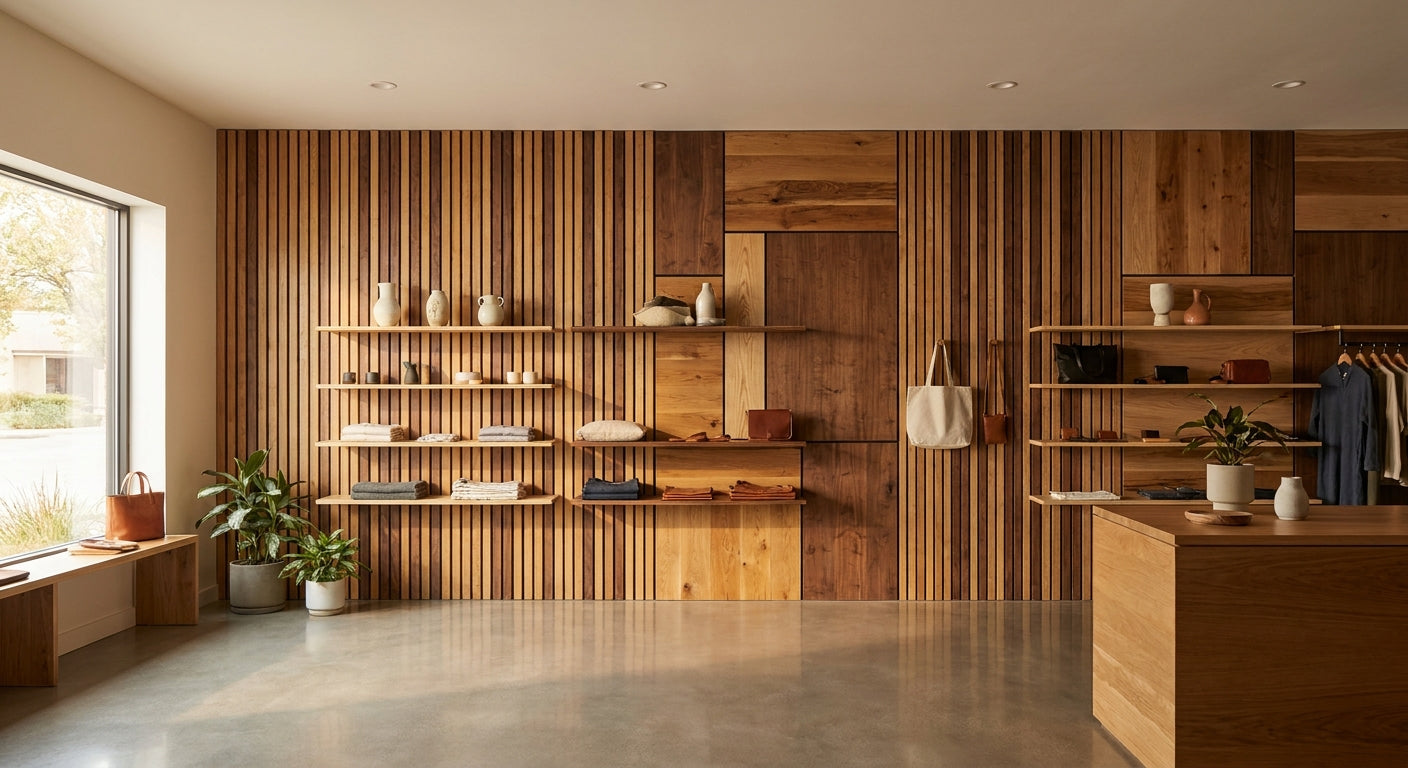
Wooden wall panels for retail shop interiors combine acoustic control, brand atmosphere, and durability in a single finish — making them one of the most practical investments a shopfitter or retailer can make in 2026.
TL;DR: For retail shop interiors in 2026, wooden wall panels from Aku Wood Panel deliver both the visual warmth customers respond to and the acoustic absorption that keeps browsing environments comfortable. Natural Oak and Smoked Oak are the strongest choices for most shop formats. Black Oak suits dark-concept boutiques. Order samples before committing to full panels — the finish reads differently under retail LED lighting than in photographs.
Why this matters for retail in 2026
Retail environments compete on sensory experience, not just product. Echo-heavy sales floors make customers feel rushed; hard, cold surfaces read as cheap regardless of stock quality. Acoustic wood panels address both problems simultaneously — the slatted construction absorbs mid-frequency sound (the frequency range of conversational speech and background music), while the natural wood veneer signals quality before a single product is examined. In 2026, independent retailers and boutique chains fitting out new locations are specifying acoustic panels at rates previously seen only in hospitality.
Who this guide is for
This guide is for retail shopfitters, interior designers specifying fit-outs, and store owners doing a considered self-build. It assumes a wall-mounted application on a standard stud or masonry substrate, a budget that prioritises longevity over the cheapest possible m² rate, and a brief that requires the finish to still look intentional in three to five years without repainting or replacement.
What to look for in wooden wall panels for retail
Veneer finish and durability
Retail walls take more indirect contact than residential walls — from merchandise, shopping bags, clothing rails, and cleaning equipment. A 3-sided wood veneer (veneer on the front face and both visible edges) holds its appearance when panels butt against fittings or fixings clip on. Single-face veneer shows raw board at every cut edge, which reads poorly under the directional lighting most retailers use. Specify 3-sided veneer for any panel within reach of customers or merchandise.
Acoustic performance specification
Not all slatted panels absorb sound equally. The felt backing material, slat width, and spacing determine the absorption coefficient. For retail, you need meaningful absorption in the 500 Hz–2 kHz range — where speech and music sit. Panels with a grey felt backing layer perform measurably better than panels with a plain MDF backing, because the felt adds mass and converts sound energy to low-level heat rather than reflecting it back into the room.
Finish tone relative to lighting
Natural Oak reads warm and neutral under 3000K–4000K LED retail lighting — the most common colour temperature in UK shopfitting. Smoked Oak introduces depth and works with darker, higher-contrast schemes. Black Oak reads almost charcoal under directional lighting and suits jewellery, eyewear, and dark-concept fashion retail. Grey Oak is the outlier: it photographs as contemporary-minimal but can feel cold in person unless the rest of the scheme introduces warmth. Order physical samples before specifying — this is not optional for a commercial project.
Panel dimensions and coverage per box
Coverage efficiency matters on a retail fit-out budget. Panels that cover more m² per box reduce both material cost and the number of joins on the finished wall. Fewer joins means a cleaner visual result, which matters in a sales environment where the wall finish is part of the display. Check the stated coverage per box against your measured wall area and factor in a 10% cut waste allowance for corners, door openings, and sockets.
Installation method compatibility
Retail fit-outs rarely have the luxury of long drying times. Panels fixed with high-tack adhesive rather than mechanical fixings go up faster and leave no visible fixings on the face. High-tack panel adhesive (290 ml cartridge format) applies with a standard sealant gun, bonds within minutes, and eliminates the need to drill through veneer. For heavy-traffic walls or panels at low level, combine adhesive with concealed mechanical fixings behind the batten for belt-and-braces security.
Sample availability
Any supplier worth specifying offers samples. For retail, samples serve two purposes: checking colour accuracy under your actual lighting conditions, and presenting options to a brand or client for sign-off. A physical sample also lets you test the panel's acoustic effect at small scale — hold it at arm's length and clap; panels with effective felt backing produce a noticeably duller sound reflection than bare MDF-backed alternatives.
Top picks for retail shop interiors
Natural Oak — the safe specification
The safe pick. Natural Oak is the most versatile finish in the Aku Wood Panel range for retail applications in 2026. The warm mid-tone works across fashion, homewares, food, and wellness retail without clashing with standard white-painted ceilings or concrete floors. The wooden wall panel natural oak is the starting point for most retail briefs where the client hasn't committed to a stronger direction.
Verdict: Buy for general retail, café-retail hybrid, and any brief asking for "warm and contemporary."
Smoked Oak — the atmospheric choice
The character pick. Smoked Oak adds a darker, more considered tone without crossing into dramatic territory. It photographs well in retail environments, which matters if the store generates social media content or press coverage. The grey undertone pairs naturally with brushed steel fittings, concrete shelving, and exposed services. Use it on a single feature wall behind a till point or product display rather than wrapping the full shop floor — it reads stronger as a focal finish.
Verdict: Buy for independent fashion, spirits retail, and design-led homewares.
Black Oak — the bold statement
The wildcard. Black Oak is a high-commitment finish. Under directional LED spotlighting it creates strong contrast that makes lighter merchandise — gold jewellery, white ceramics, light-coloured packaging — stand out sharply. It demands a scheme that leans into the darkness rather than fighting it. Not suitable for small or low-ceilinged retail spaces where it will make the room feel compressed.
Verdict: Consider for jewellery, eyewear, beauty, and concept boutiques with ceiling heights above 2.8 m.
Natural Oak with Grey Felt — the acoustic-first choice
The performance pick. When acoustic control is the primary brief — a busy café-retail space, a shop playing music at significant volume, or a store with hard floors and no soft furnishings — the wooden wall panel natural oak grey felt adds measurable absorption over the standard Natural Oak panel. The grey felt visible between slats also reads as a design detail rather than a functional compromise.
Verdict: Buy when acoustic control matters as much as aesthetics.
Rustic Oak Premium — the premium tier
The premium pick. The wooden wall panel rustic oak premium 3-sided wood veneer is the specification for retailers where the wall finish needs to read as a material investment. The 3-sided veneer holds its finish at every edge, which is critical when panels are cut around fittings, outlets, or bespoke joinery. Position it in high-visibility zones: behind counters, at the entrance, or as a full feature wall opposite the door.
Verdict: Buy for flagship stores, premium food retail, and any brief with a visible design budget.
Finish comparison table
| Finish | Tone | Grey Felt Option | Best Use Case | Retail Risk |
|---|---|---|---|---|
| Natural Oak | Warm mid-tone | Yes | General retail, café-retail | Very low |
| Smoked Oak | Dark warm | Yes | Fashion, spirits, design retail | Low |
| Black Oak | Near-charcoal | No | Jewellery, concept boutiques | Medium (size/height dependent) |
| Grey Oak | Cool neutral | No | Contemporary minimal | Medium (can read cold) |
| Rustic Oak Premium | Textured warm | No | Flagship, premium food | Low |
What to avoid
- Specifying without a physical sample under retail lighting. Finishes that look warm in a daylit showroom or on a screen can read cold or flat under the 4000K LED spots common in UK retail. Always get a sample on-site before ordering full panels.
- Single-face veneer panels at low level. Any panel that will be cut to fit around skirting, floor boxes, or low-level fittings will expose raw board edge if the veneer only covers the front face. This is visible at customer eye level and degrades the finish instantly.
- Wrapping an entire small shop floor in a dark finish. Black Oak and Smoked Oak are feature-wall finishes in sub-50 m² retail units. Using them on all four walls in a small space creates a tunnelling effect that shortens dwell time.
FAQ
What are the best wooden wall panels for a retail shop interior in 2026? Natural Oak and Smoked Oak from Aku Wood Panel are the strongest choices for most retail formats in 2026. Natural Oak suits general retail and café-retail hybrid spaces; Smoked Oak works for fashion, spirits, and design-led stores. Both are available with grey felt backing for improved acoustic performance.
Do acoustic wood panels actually reduce noise in retail environments? Yes, when specified correctly. Panels with a felt backing layer absorb sound in the 500 Hz–2 kHz range — the frequency band covering speech and music. A hard-backed slatted panel with no felt delivers minimal acoustic benefit; the felt layer is what converts sound energy rather than reflecting it.
How do I fix wooden wall panels in a retail shop? High-tack panel adhesive in a 290 ml cartridge is the fastest installation method and leaves no visible fixings on the panel face. For low-level panels or high-traffic walls, combine adhesive with concealed mechanical fixings for additional security. Standard plasterboard, masonry, and batten substrates are all compatible.
Can I use wooden wall panels in a retail shop with a rental lease? Adhesive-fixed panels on a batten frame are removable in principle, though removal risks surface damage to the underlying wall. If your lease requires making good on exit, discuss the fixing method with your landlord before specifying. Mechanically fixed panels on a batten frame are more straightforward to remove cleanly.
How do I choose between Natural Oak and Smoked Oak for my shop? If your fittings are light-toned (white, cream, natural timber), Natural Oak is the safer choice. If your fittings run to dark metals, concrete, or black powder-coat, Smoked Oak will integrate better. Order a sample of each and hold them against your existing or planned fixtures under the actual lighting you'll use.
Are wooden wall panels suitable for a retail shop kitchen or food prep area? Aku Wood Panel's interior wooden wall panels are not rated for high-humidity or food-contact zones. They are appropriate for the retail sales floor, changing rooms, and back-of-house dry areas. For kitchen splashbacks or food prep walls, a different substrate is required.
How many panels do I need for a retail feature wall? Measure the wall area in m², add 10% for cut waste, then divide by the coverage stated per box for the panel you select. A standard retail feature wall of 3 m wide by 2.7 m high equals 8.1 m² — approximately 9 m² with waste included. Check the product page for exact coverage per box before ordering.
What is the lead time for wooden wall panels for a retail fit-out? For in-stock finishes, Aku Wood Panel dispatches to UK addresses with standard lead times appropriate for planned fit-out schedules. Order samples at least two weeks before your panel order to allow time for client or brand approval before committing.
One last thing
The till point or checkout counter is the one wall every customer faces at close range for at least 30 seconds. If budget forces a choice, spend the acoustic and finish specification here. A Rustic Oak Premium or Smoked Oak feature wall behind the counter creates a focal point that customers photograph, remember, and associate with the brand — at a fraction of the cost of bespoke joinery.
Share:
Acoustic Wall Panels for Home Cinema Rooms 2026
Black Oak Wall Panels for Feature Walls 2026