

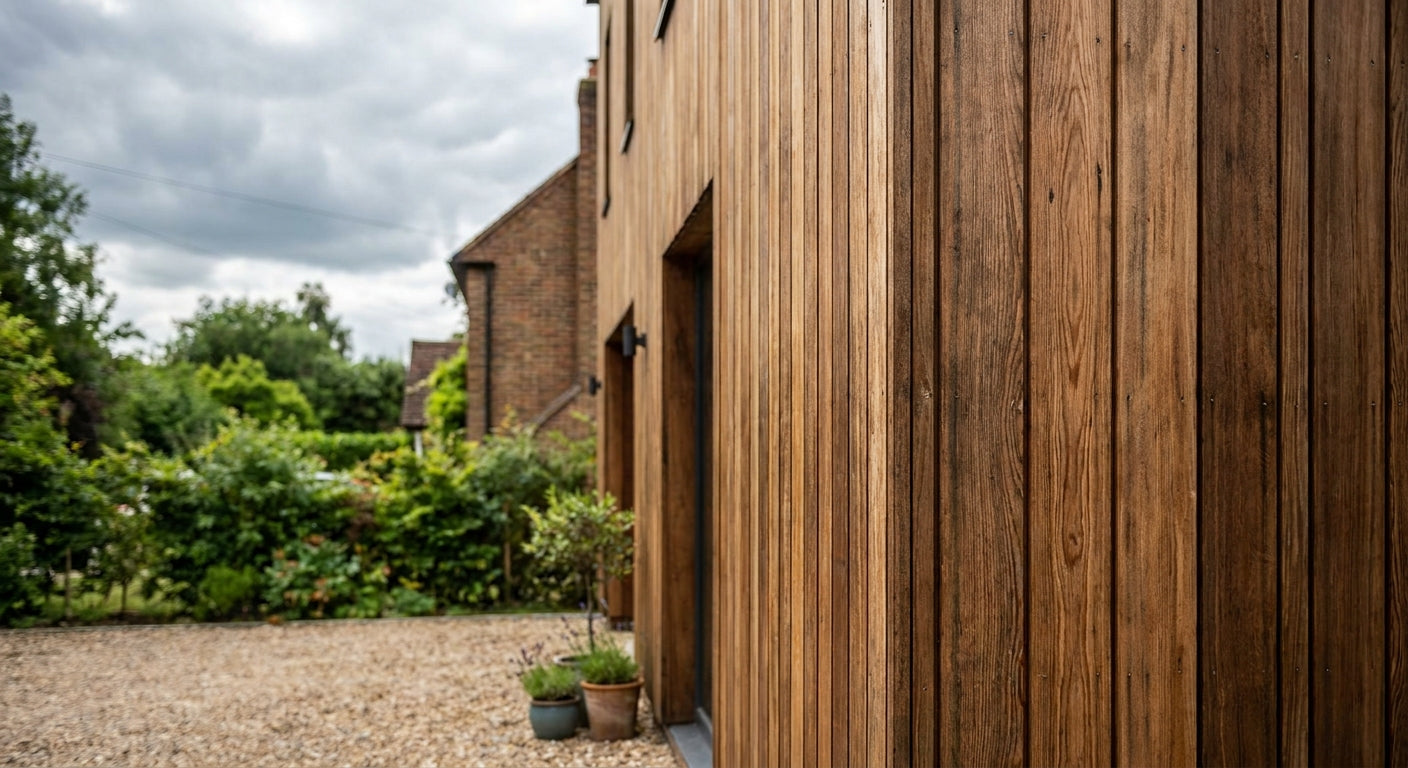
Thermowood cladding promises the look of real timber with the durability of a factory heat-treatment process, but UK weather still tests it hard. This guide covers what to check before buying thermowood cladding for UK exteriors, plus a maintenance-free composite alternative worth comparing it against.
- Genuine thermowood cladding needs re-oiling every 2-3 years in the UK climate — budget for it or skip.
- Akuwood Panel's composite exterior wall cladding panels carry a 25-year maintenance-free claim, the strongest alternative for 2026 builds.
- Black and oak composite panels hold colour through UK rain and UV exposure without cupping — Buy for new-build facades.
- Untreated or unrated softwood cladding sold as thermowood without certification silvers and cups within two UK winters — Skip.
Why this matters
Thermowood is softwood, usually pine or spruce, heated to between 160°C and 230°C without chemicals. The process locks out moisture and stops rot, which is why it turns up on UK garden rooms, extensions and self-builds. What it does not stop is UV bleaching, so the warm brown tone fades to silver-grey within 6 to 12 months outdoors unless you keep re-oiling it.
That maintenance cycle is the real cost of thermowood cladding, not the initial board price. Anyone comparing it for a UK exterior in 2026 needs to weigh that ongoing labour against composite panels that are finished once and left alone. Guidance on choosing outdoor wall cladding for UK homes covers the wider material shortlist if thermowood turns out to be the wrong fit.
Who this is for
This guide is for UK homeowners and self-builders specifying exterior cladding for a house extension, garden room or outbuilding, and for anyone who has been quoted thermowood boards and wants to know what they're actually signing up for in terms of upkeep. It's also for tradespeople fielding client questions about why a thermowood facade looks patchy after one winter.
What to look for in thermowood cladding for UK exteriors
Heat-treatment certification
Genuine thermowood is processed under a controlled kiln cycle, typically 160-230°C, which is what gives it dimensional stability. Ask the supplier for the treatment class and batch documentation — cladding marketed loosely as "thermo-treated" without a certificate is often just kiln-dried softwood with a marketing label.
UV and colour stability
Every thermowood board loses its rich brown colour outdoors. The question is how fast, and whether the supplier specifies a UV-stable oil for re-coating. If nobody can tell you the re-oiling interval, assume it's shorter than they're admitting.
Moisture movement
Heat treatment reduces moisture uptake but doesn't eliminate seasonal movement. Boards need an expansion gap at fixing points and a ventilated batten cavity behind them — skip this and you get cupping within a UK winter, especially on south and west-facing walls that see the most rain-then-sun cycling.
Fixing and ventilation gap
A cladding system fixed direct to a solid wall without a battened air gap traps moisture against the timber. This matters more in the UK than in drier climates because rainfall is frequent rather than heavy, so walls rarely get a long dry spell to release trapped damp.
Maintenance schedule vs lifetime cost
Compare the sticker price of thermowood boards against the cost of re-oiling every 2 to 3 years across a 20-year hold. A composite panel with a 25-year maintenance-free claim can undercut thermowood on total cost even at a higher upfront price per board.
Colour and finish match
If the facade needs to match render, brick, or an existing extension, check finish options before committing. Thermowood typically comes in one or two tones; composite wood-grain panels come in a wider spread including black, birch, oak and stone grey.
Top picks for thermowood cladding vs alternatives
Genuine thermowood boards — the traditional pick. Heat-treated pine or spruce, no chemical preservatives, needs re-oiling roughly every 2-3 years to hold colour. Consider it if you want real timber and don't mind the upkeep; Skip it if you want a facade you never touch again.
Akuwood Panel Exterior Wall Cladding Panel Oak, 290cm — the low-maintenance oak look. Composite 3D wood-grain finish, UV and weather resistant, backed by an over-25-year maintenance-free claim from the manufacturer. At £41.95 per panel it competes directly with thermowood boards on price without the re-coating cycle. Buy for oak-toned facades where you want the grain look without the upkeep.
Akuwood Panel Exterior Wall Cladding Panel Black, 290cm — the modern new-build pick. Same UV and weather-resistant composite construction in a matt black wood-grain finish, suited to contemporary extensions and garden rooms. Buy if the brief calls for a dark, low-maintenance facade in 2026.
Akuwood Panel Exterior Wall Cladding Panel Birch, 290cm — the lighter Scandinavian tone. Same durability claim as the oak and black variants, in a pale birch grain that reads warmer than raw thermowood once it's silvered. Consider for garden buildings where you want a light finish that won't need touching up.
Akuwood Panel Exterior Wall Cladding Panel Stone Grey, 290cm — the render-matching option. Pairs with rendered facades where thermowood's brown tone would clash once it fades to grey anyway. Buy if the project already has grey render or stone detailing nearby.


What to avoid
- Unrated softwood sold as "thermowood" with no batch certificate — it's regular kiln-dried timber and will move and rot faster than the real thing.
- Direct-to-wall fixing with no ventilated batten gap — looks fine on installation day, traps moisture within one UK winter.
- Cladding with no stated UV-stable oil recommendation — you'll be guessing at re-coating intervals and voiding any supplier guidance by accident.
Verdict comparison
| Option | Maintenance | Colour stability | Best for | Verdict |
|---|---|---|---|---|
| Genuine thermowood boards | Re-oil every 2-3 years | Fades to grey without upkeep | Buyers who want real timber | Consider |
| Akuwood Panel Oak composite | None claimed, 25+ years | Fixed wood-grain finish | Oak-toned facades | Buy |
| Akuwood Panel Black composite | None claimed, 25+ years | Fixed matt black finish | Modern new-build in 2026 | Buy |
| Akuwood Panel Birch composite | None claimed, 25+ years | Fixed light finish | Garden buildings | Consider |
| Akuwood Panel Stone Grey composite | None claimed, 25+ years | Fixed grey finish | Render-matched facades | Buy |
FAQ
What is thermowood cladding?
Thermowood cladding is softwood, usually pine or spruce, heat-treated at 160-230°C without chemicals to improve rot resistance and dimensional stability. It still needs regular re-oiling outdoors in the UK to hold its colour.
How long does thermowood cladding last in the UK?
The timber itself can last decades once heat-treated, but the colour fades to silver-grey within 6-12 months without re-oiling. Structural lifespan depends on correct ventilated fixing, not just the heat treatment.
Is composite cladding better than thermowood for UK exteriors?
Composite wood-grain panels like Akuwood Panel's exterior cladding range carry a 25-year maintenance-free claim, which beats thermowood's 2-3 year re-oiling cycle for anyone who wants a facade they never touch again.
Does thermowood cladding need painting or oiling?
Yes, if you want to keep the original brown tone. Left untreated after installation, thermowood silvers within its first year outdoors regardless of the heat-treatment quality.
What's the cost difference between thermowood and composite cladding?
Board prices are broadly comparable, but thermowood adds ongoing re-oiling labour every 2-3 years. Akuwood Panel's composite panels sit around £41.95 per 290cm panel with no stated recoating requirement.
Can thermowood cladding be fixed direct to a solid wall?
No, it needs a ventilated batten gap behind it. Fixing direct to render or brick traps moisture and causes cupping within a single UK winter.
What colours does composite exterior cladding come in?
Akuwood Panel's exterior wall cladding range includes oak, birch, black and stone grey finishes, giving more colour choice than the one or two tones typical of raw thermowood boards.
Is thermowood cladding suitable for a north-facing wall?
North-facing walls fade more slowly since they get less direct UV, but they also dry more slowly after rain, so ventilated fixing matters even more there than on sun-facing elevations.
One last thing
The heat treatment that makes thermowood rot-resistant does nothing to stop UV bleaching — that's a separate mechanism entirely, which is why a certified, well-treated board can still look patchy grey by its second UK summer while structurally it's fine. If colour retention matters as much as rot resistance, that's the gap a factory-finished composite panel closes and raw thermowood can't.
Share:
MDF Slatwall Panels for Shop Displays: 2026 Verdict
Best Slatwall Panels for Retail Shop Fitouts 2026