

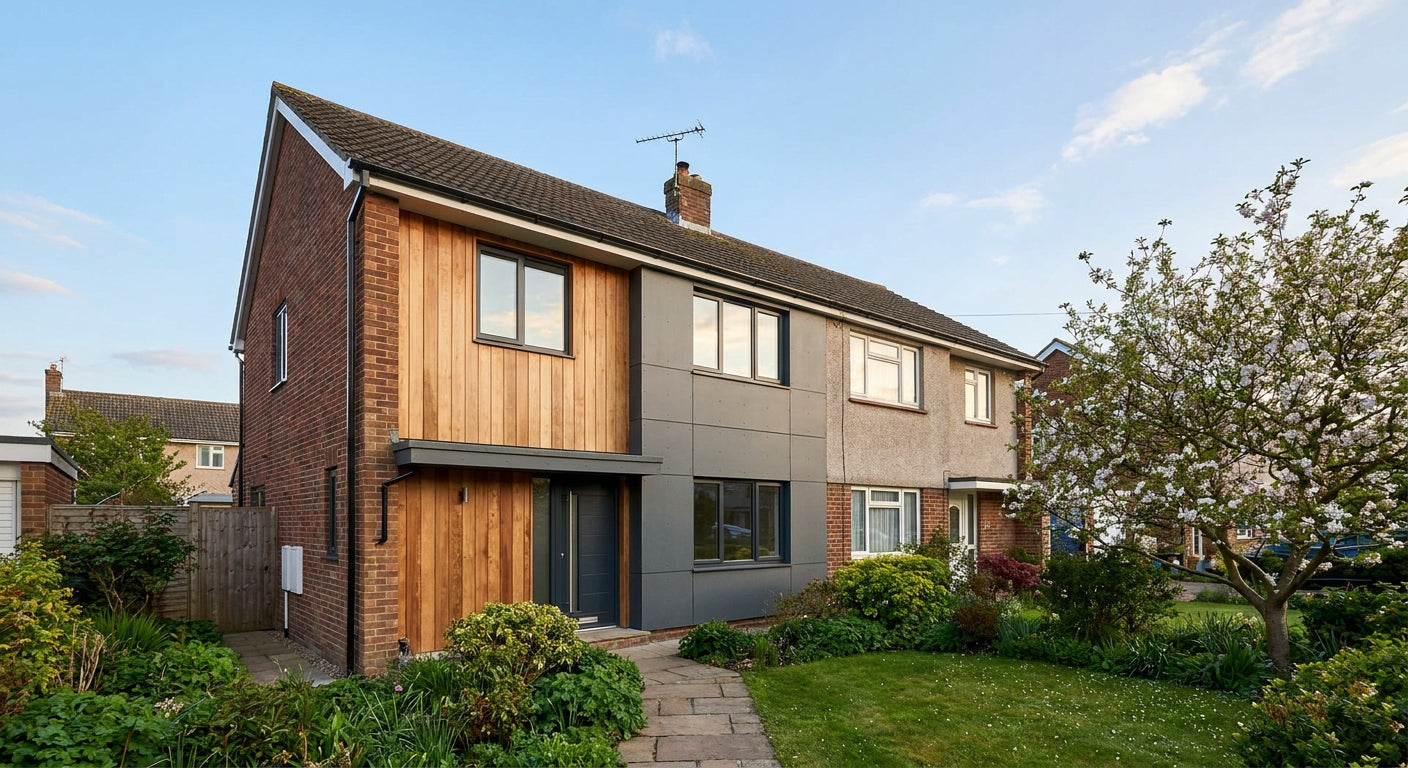
Choosing external cladding for a semi-detached house is not just a cosmetic decision — it affects weather resistance, maintenance demands, planning rules, and how well the finish holds up against a shared wall that you cannot fully control. This guide covers who this purchase suits, what to look for, which formats work best on semi-detached properties in 2026, what to avoid, and how the options compare side by side.
TL;DR: External cladding for semi-detached houses works best when it is low-maintenance, UV-stable, and sympathetic to the original masonry so it does not clash with the adjoining half. In 2026, composite and engineered wood-effect panel systems — including the Akustiq UK exterior cladding range in Stone Grey, Oak, Black, and Birch — are the most practical choices. They install over brick or render without structural work, require no annual painting, and are available in matching corner trims and finishing strips that give a clean edge against party walls and window reveals.
Why this matters for semi-detached homes in 2026
Semi-detached houses present a specific set of cladding problems that detached properties do not. You share at least one elevation with a neighbour, which means your cladding choice is visible on both sides of the building line. Planning rules under Permitted Development in England allow external cladding on semi-detached houses as long as the material is not stone, artificial stone, pebbledash, render, timber, or plastic cladding on a dwelling in a designated area — but local authorities can remove those rights via an Article 4 Direction, and Conservation Area properties require consent regardless. Always check with your local planning authority before ordering materials.
Beyond planning, the shared wall means moisture management is critical. Cladding that traps water between the panel and the substrate will cause long-term damage that spreads to the party wall structure. Ventilated systems — panels fixed on a batten framework with an air gap — are the correct approach for any UK semi in 2026.
Who this guide is for
This guide is written for homeowners who own or are buying a semi-detached house and want to re-clad part or all of the exterior — whether that is the front elevation, the side return, a single-storey rear extension, or the full façade. It is equally relevant if you are a self-builder fitting cladding to a new-build semi, or a landlord refreshing a rental property to reduce ongoing maintenance costs. If you are looking to clad a garden building, outbuilding, or garage rather than the main house, the decisions are broadly the same but planning constraints are lighter.
What to look for in external cladding for a semi-detached house
Weather resistance and UV stability
UK weather is the main enemy of exterior cladding. A semi-detached house typically has at least one elevation exposed to prevailing wind and rain — often the side wall, which has no shelter from neighbouring gardens. You need panels that are rated for continuous outdoor exposure, will not warp when wet, and will not fade significantly within 5 years. Composite and engineered wood-effect boards with a UV-resistant coating consistently outperform untreated timber in this regard and do not require annual oiling or staining.
Ventilation gap behind the panel
Trapped moisture causes rot in timber substrates and efflorescence in brick. Any cladding system you choose should be installed on pressure-treated timber battens at a minimum 25 mm standoff from the wall face. This air gap allows condensation to escape, keeps the panel dry from behind, and extends the life of both the panel and the substrate significantly. Skipping the batten and glueing directly to an external wall is the single biggest installation mistake on semi-detached houses.
Party wall edge detailing
Where your cladding meets the shared party wall, you need a clean, weatherproof termination. Exposed panel ends absorb water and degrade faster than the face of the board. Matching corner trims and finishing strips — cut to size on site — create a sealed edge that looks intentional and protects the panel core. Check before you buy that the supplier stocks finishing trim and corner trim in the same finish as the main panel; mismatched trims look cheap and are difficult to source later.
Panel format and coverage
Larger format panels reduce the number of horizontal joints, which means fewer water entry points and a cleaner visual result. On a typical semi-detached two-storey front elevation of roughly 24–28 m², fewer, longer boards complete the job faster and with less waste. Check the panel length and the coverage per board before calculating your order quantity.
Colour and finish relative to the neighbouring half
A semi-detached house that is clad in a dramatically different colour to the adjoining property can look unfinished or attract planning objections even where consent is not technically required. Neutral tones — stone grey, natural oak, birch — tend to sit comfortably alongside unpainted brick or rendered render. Bold choices like black work well on modern rear extensions and single-storey additions where the contrast is deliberate and contained.
Maintenance demand
The main reason homeowners choose engineered cladding over painted timber is maintenance. Painted timber on an exposed semi-detached elevation needs repainting every 3–5 years, costing several hundred pounds in materials and labour each cycle. Composite and engineered wood-effect panels need only an annual wash with a brush and soapy water to stay clean and retain their colour.
Top picks for external cladding on a semi-detached house
Stone Grey — the safe pick
The exterior wall cladding panel in Stone Grey is the lowest-risk choice for a semi-detached house on a traditional street. The muted grey tone works alongside unpainted brick, white render, and grey UPVC windows without creating a visual clash with the adjoining property. It reads as a deliberate, contemporary upgrade rather than a bold statement.
Verdict: Buy. This is the right default for front elevations and side returns on Victorian and Edwardian semis where you want an upgrade that reads as considered rather than controversial.
Oak — the warm-toned alternative
The exterior wall cladding panel in Oak brings a warm timber look without the maintenance of real wood. It suits semis in areas where brick is the dominant material and homeowners want the cladding to feel warm rather than industrial. The oak tone works particularly well on single-storey rear extensions where the cladding is visible mainly from the garden.
Verdict: Buy for rear and side elevations. Consider carefully for front elevations where your neighbour's half remains unpainted brick — the contrast can be attractive, but it depends on the street.
Black — the bold choice for modern extensions
Black exterior cladding reads as a deliberate architectural choice. It suits rear extensions on Victorian semis where the design language is intentionally modern, flat-roof additions, and new-build semis with contemporary lines. On a traditional front elevation it can attract planning attention in sensitive areas.
Verdict: Buy for modern rear extensions. Consider carefully for front elevations — check your local planning authority's stance before ordering. More detail on this finish is in the black exterior cladding panels for modern homes article.
Birch — for garden buildings and outbuildings on the same plot
Birch is a lighter, cooler tone that works well on detached garden rooms, garages, and outbuildings on the same plot as the semi. Using the same panel system across the main house extension and a garden building creates a coherent property-wide aesthetic.
Verdict: Consider for main house cladding. Buy if you are matching cladding to a garden building already fitted in birch.
What to avoid
- Direct adhesive fixing to an external wall without battens. This traps moisture, voids any product warranty, and causes panels to delaminate within 2–3 years on a UK exterior. Always use a ventilated batten system.
- Mismatched or missing trim at window reveals and party wall edges. Exposed panel ends are the fastest point of failure on any cladding system. Order corner trim and finishing trim in the matching finish at the same time as the main panels — do not add them as an afterthought.
- Cladding over active damp without treating the source first. Panels installed over a wall with rising damp or failed pointing will trap the problem behind a decorative face. Fix the substrate before cladding, not after.
Comparison table
| Finish | Best elevation | Maintenance | Party wall risk | Planning sensitivity |
|---|---|---|---|---|
| Stone Grey | Front, side, rear | Wash annually | Low | Low |
| Oak | Rear, side | Wash annually | Low–medium | Low |
| Black | Rear extension | Wash annually | Low | Medium–high |
| Birch | Garden buildings, outbuildings | Wash annually | Low | Low |
FAQ
Do I need planning permission to clad a semi-detached house in the UK? In most cases in England, you can clad a semi-detached house under Permitted Development without a formal application, provided the material is not specifically excluded and your property is not in a Conservation Area or subject to an Article 4 Direction. Always confirm with your local planning authority before work starts — the rules vary by location and the cost of getting it wrong is high.
What is the best external cladding for a semi-detached house in 2026? Composite and engineered wood-effect panel systems are the best-performing option in 2026 for UK semi-detached houses. They resist moisture, require no painting, and are available in finishes that work alongside traditional brick and render. The Akustiq UK exterior cladding range covers stone grey, oak, black, and birch in a single system with matching trims.
How long does external cladding last on a semi-detached house? A properly installed composite or engineered cladding system on a ventilated batten framework lasts 20–30 years with only basic cleaning maintenance. Untreated timber cladding without regular oiling or painting degrades significantly within 5–7 years on an exposed UK elevation.
Can I clad just one side of a semi-detached house? Yes. Partial cladding — for example, a rear extension or side return only — is common and usually lower risk from a planning perspective. Ensure the panel terminates cleanly at every edge with matching finishing trim rather than leaving cut ends exposed.
Does external cladding improve insulation on a semi-detached house? Cladding panels alone provide minimal thermal improvement. If insulation is the goal, the correct approach is to fit rigid insulation board to the external wall face before installing the batten framework and cladding over it. This adds meaningful U-value improvement but requires careful detailing around windows and doors.
How do I fix cladding panels around windows and doors on a semi? Window and door reveals require finishing trim cut to fit the depth of the reveal. The trim creates a weatherproof junction between the panel face and the window frame. Akustiq UK stocks finishing trim in all four panel finishes. More detail is in the how to fix exterior cladding around windows and doors guide.
What colour external cladding works best alongside unpainted brick on a semi? Stone grey and birch are the safest choices alongside unpainted red or London stock brick. Both tones are neutral enough not to clash with the exposed masonry on the adjoining half of the property. Oak works where you want warmth. Black works only where the design intent is clearly contemporary.
Do I need special fixings for external cladding on a semi-detached house? Yes. Use stainless steel or coated screws designed for exterior use — standard zinc-plated fixings will rust and stain the panel face within 2–3 years in a UK climate. Akustiq UK supplies colour-matched exterior cladding screws in all four finishes so fixings do not show against the panel face.
One last thing
The party wall between your half and your neighbour's is a legal boundary under the Party Wall Act 1996 — but cladding your own external leaf does not constitute party wall works in most cases, because you are not touching the shared structure. What does matter is that your batten fixings go into your masonry only, and that rainwater shedding from your cladding does not discharge onto your neighbour's property. Get both of those details right at the planning stage and you will avoid the two most common disputes that slow semi-detached cladding projects down in 2026.
Share:
Outdoor Cladding for Flat Roof Extensions 2026
Outdoor Wall Panels for House Exteriors: 2026 Guide