

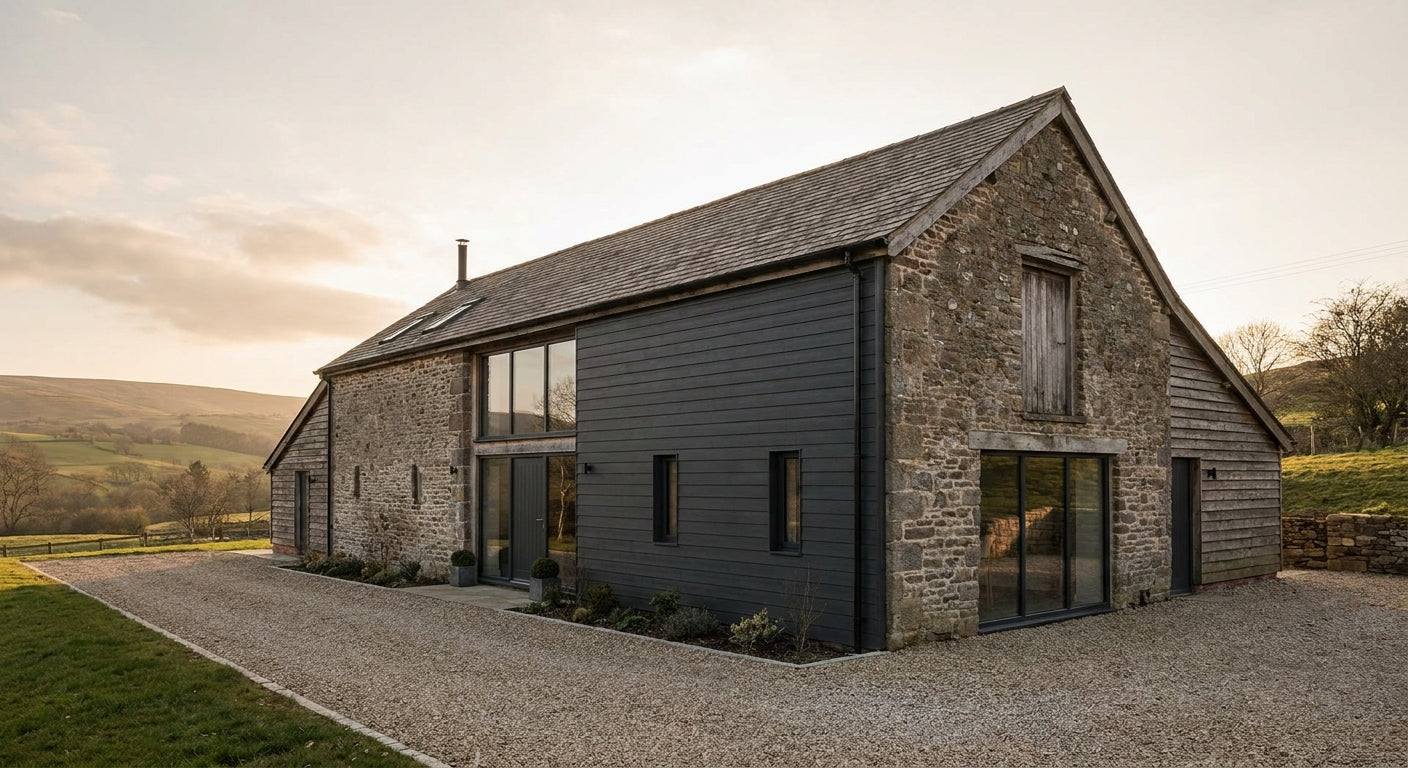
Barn conversions put cladding under pressure that most residential projects never face — wide, exposed elevations, planning constraints, and an expectation that the finish will look premium for decades. Composite cladding for barn conversion exteriors solves all three problems at once, provided you pick the right product and install it correctly.
TL;DR
Composite cladding is the practical default for barn conversion exteriors in 2026. It resists moisture, frost, and UV without annual maintenance, and a black woodgrain profile reads as contemporary barn aesthetic without the rot risk of real timber. Akustiq UK's exterior wall cladding range delivers that finish in panels built for UK weather. If you're converting a barn and want a low-maintenance exterior that satisfies planners and looks sharp, composite is the answer — timber-effect black is the safest finish choice.
Why composite cladding suits barn conversions specifically
Barns are big, exposed structures. A typical agricultural conversion covers 150–400 m² of exterior wall, much of it south- or west-facing and unshielded by neighbouring buildings. That means prolonged UV exposure, wind-driven rain, and freeze-thaw cycles every winter — conditions that age untreated timber in 5–7 years and push painted finishes into annual maintenance cycles.
Composite panels are engineered to absorb none of that. A core of compressed wood fibre and polymer binders carries a textured surface that mimics sawn timber grain without the moisture uptake. In 2026, most UK planners accept composite cladding on barn conversions subject to colour and profile conditions — dark, matte, board-profile finishes are almost universally approved where natural timber would have been the historic material.
Who this guide is for
You are converting a barn — agricultural, redundant, or semi-derelict — into a residential or mixed-use property. You have an exterior elevation to clad, either the full shell or a section replacing failed timber. You want a product that:
- Satisfies planning conditions (dark matte finish, vertical or horizontal board profile)
- Requires no annual oiling, painting, or retreating
- Handles UK weather without warping, splitting, or colour fade over a 25-year horizon
- Looks deliberately contemporary rather than accidentally cheap
This guide is not for internal feature walls — see the interior panel range for that application.
What to look for in composite cladding for a barn conversion
Weather resistance rated for UK exposure
Barn conversions sit in open countryside. The cladding you specify must handle driving rain at Exposure Zone 3 or 4 (as defined by BS 8104) without water ingress behind the boards. Look for panels with a closed-cell or sealed-edge profile and a documented water absorption rate below 1%. Avoid open-groove profiles on west and south elevations — water tracks into the groove and stays there.
UV stability over a minimum 15-year horizon
Black and dark-grey finishes absorb more solar energy than light colours, which accelerates surface degradation in lower-grade composites. A product that specifies co-extruded colour (pigment locked into the outer cap layer, not surface-painted) will not bleach, chalk, or mottle. Ask for the manufacturer's fade warranty before you specify; anything under 10 years is a warning sign for a barn conversion context.
Profile and texture that reads as timber
Planners reviewing a barn conversion application in 2026 are experienced at spotting plastic-looking substitutes. The surface texture needs visible grain depth — not printed grain, but a pressed or embossed profile that casts real shadow. Board widths between 150 mm and 220 mm match traditional featheredge and shiplap proportions and will satisfy most Local Planning Authority conditions without a material amendment.
Fixing system that allows thermal movement
Composite boards expand and contract with temperature. On a south-facing barn elevation with a temperature swing of 40°C between January and July, a 3 m board can move 4–6 mm longitudinally. Any fixing system that does not accommodate this will buckle or split the board within two winters. Hidden clip systems or slotted face-fix holes are the correct detail — through-fixed with no slot is not acceptable on a long run.
Compatibility with a ventilated cavity
Building Regulations Part C requires a ventilated cavity behind external cladding in most barn conversion scenarios. The panel profile must allow a minimum 25 mm clear cavity to battens and must not obstruct airflow at head and sill. Solid flat-back panels work well; profiled-back panels can create pockets — check the installation detail sheet before ordering.
Planning-safe colour and finish
Dark matte black and charcoal are the finishes most commonly approved on barn conversions across England and Wales in 2026. They read as contemporary agricultural and create the high-contrast look most conversion architects aim for. Mid-grey is a safe secondary choice. High-gloss, white, or light-wood finishes are regularly refused on open-countryside sites — confirm with your LPA before you commit to a colour.
Top picks from Akustiq UK's exterior range
The safe pick — Black exterior cladding panel
Hook: The default spec for a barn conversion that needs to clear planning without a fight.
The exterior wall cladding panel in black carries a woodgrain-embossed face in a matte black finish. The profile sits at a board width that matches traditional barn boarding proportions, and the matte surface reads as contemporary without looking synthetic. It is the product most directly suited to an agricultural conversion context in 2026.
One spec that matters: the woodgrain embossing creates genuine shadow depth, so the elevation has visual texture rather than the flat sheen that gets refused at planning.
Verdict: Buy. For a barn conversion exterior, this is the lowest-risk, highest-compliance choice.
The interior complement — Rustic Oak veneer panel
Hook: For the internal barn walls where you want the grain aesthetic to continue inside.
Once your exterior is clad, the interior elevations of a converted barn often need the same warmth that the timber frame used to provide. The rustic oak premium 3-sided wood veneer panel uses real wood veneer on three faces and an acoustic felt backing — ideal for the open-plan interiors that barn conversions typically produce, where echo is a real problem.
Verdict: Consider for interior barn walls where the open-plan volume creates acoustic issues alongside aesthetic ones.
The dark interior alternative — Black Oak veneer panel
Hook: For interior feature walls where you want the black exterior theme to continue inside.
If the exterior is black and you want the interior palette to follow through, the wooden wall panel in black oak delivers a dark, smoky grain that bridges exterior and interior without the two feeling disconnected. Works particularly well on a gable-end feature wall facing the main living space.
Verdict: Consider when the design brief calls for a continuous dark palette from outside to inside.
What to avoid
- Hollow-core composite boards on large elevations. They sound hollow when tapped, flex visibly between fixings, and read cheap from 5 metres. Barn elevations are seen from a distance; board rigidity matters.
- Open-groove profiles on exposed elevations. The groove collects debris, retains moisture, and on dark colours shows as a permanent dirt line within 18 months. Use a shiplap or rebated profile.
- Surface-painted rather than through-coloured composite. Paint chips at fixing points and at cut ends. On a 300 m² elevation with 40 linear metres of cuts, the number of exposed pale cut edges will look wrong within a year. Specify co-extruded or through-coloured only.
Comparison table
| Criterion | Black Exterior Panel | Rustic Oak Veneer (interior) | Black Oak Veneer (interior) |
|---|---|---|---|
| Weather resistance | High — composite exterior-rated | N/A — interior only | N/A — interior only |
| UV stability | Co-extruded matte finish | N/A | N/A |
| Planning-safe colour | Yes — dark matte black | N/A | N/A |
| Thermal movement allowance | Slotted fixing system | Panel adhesive/clip | Panel adhesive/clip |
| Acoustic performance | None (exterior only) | Felt backing — absorbs echo | Felt backing — absorbs echo |
| Best for | Full exterior elevation | Open-plan interior walls | Dark interior feature walls |
| Verdict | Buy | Consider | Consider |
FAQ
What is the best composite cladding finish for a barn conversion? Matte black is the strongest choice in 2026. It reads as contemporary agricultural, satisfies most LPA colour conditions on open-countryside sites, and does not show the grain fade or chalking that affects lighter-coloured composites over time.
Do I need planning permission to clad a barn conversion exterior? Yes, in almost every case. Barn conversions are typically Class Q or full planning developments, and the exterior material is a controlled element. Submit a cladding specification with colour chip and texture sample to your LPA before ordering — most will confirm approval within the pre-application advice process.
Is composite cladding better than timber for a barn conversion? For a barn conversion, yes. Real timber requires oiling or painting every 2–3 years, is vulnerable to woodworm and fungal decay on exposed agricultural sites, and can split at large-format board widths. Composite eliminates all three problems with no meaningful visual compromise when a quality woodgrain profile is specified.
How long does composite cladding last on a barn conversion? A co-extruded composite board with a UV-stable cap layer carries a typical lifespan of 25–30 years with no maintenance beyond an annual wash. Surface-painted composites perform for 10–15 years before requiring refinishing.
Can composite cladding be fitted to an existing brick or stone barn wall? Yes. A batten-and-counter-batten system fixed to the masonry creates the 25 mm ventilated cavity required by Part C. Composite boards then fix to the battens. The detail is the same whether the substrate is stone, brick, or block.
How much does composite cladding cost per m² for a barn conversion? Installed cost varies with location and access — open countryside sites often carry a scaffolding premium. Material cost alone for quality composite boards in 2026 typically runs between £30 and £60 per m², excluding fixings, battens, and trims. A 200 m² elevation project sits in the £6,000–£12,000 material-only range.
Will composite cladding add value to a barn conversion? A low-maintenance exterior is a measurable selling point on a barn conversion. Buyers understand that timber needs recurring maintenance; composite removes that liability. Estate agents on rural properties report that composite-clad conversions carry a perception of quality that supports asking price, though specific uplift figures depend on location and specification.
Can I combine composite exterior cladding with wooden interior panels? Absolutely — it is one of the most effective design moves on a barn conversion. The black exterior composite reads as contemporary from the outside; real wood veneer panels on internal walls deliver warmth and acoustic absorption inside. The contrast between the two registers as intentional design rather than inconsistency.
One last thing
The single most common specification error on barn conversion cladding projects in 2026 is ordering boards cut to length at the merchant and not allowing for thermal movement gaps at abutments. A 6 m run of composite board needs a 6–8 mm expansion gap at each end junction. Leave it out and the boards bow within one summer. Build it in from the start and the installation looks sharp and performs for 25 years.
Share:
Exterior Cladding Panels for Rendered Walls 2026
Exterior Cladding for Timber Frame Extensions 2026